“So long as we do not through thinking, experience what is, we can never belong to what will be . . . . The flight into tradition, out of a combination of humility and presumption, can bring about nothing in itself other than self-deception and blindness in relation to the historical moment.”
Martin Heidegger
IMPLEMENTING THE KNOWLEDGE ECONOMY: THE THEORY AND PRACTICE OF TELEWORK
I. Introduction 1
1.1 Definition of Telework 1
1.2 Observations regarding Telework Data Issues 2
1.3 Telework as a Multidimensional Phenomenon 3
1.3.1 Perspectives of Telework 3
1.3.2 Telework: Institutional Dimensions 4
1.3.3 Telework: Triple Bottom Line 6
1.4 The Telework Compass 7
II. Telework and the Individual 11
2.1 Introduction 11
2.2 Social Aspects 12
2.3 Environmental Aspects 16
2.4 Economic Aspects 18
2.5 Productivity 19
2.6 Summing Up 21
III. Telework and the Organizational Unit 22
3.1 Introduction 22
3.2 The Benefits of Telework from the Organizational
Perspective 25
3.2.1 Network Economics 25
3.2.2 Environmental, Social and Economic Benefits 27
3.3 Managing Telework at the Organizational Level 31
3.3.1 Organizational Policy and Administration 31
3.3.2 Communications and Knowledge Transfer 33
3.3.3 Culture and Technology 35
3.3.4 Implementation Issues 36
3.4 Case Study – Moving an Organization to Highly Virtual 38
3.4.1 Scope and Background 38
3.4.2 Implementation 39
IV. Telework at the Level of the Firm 44
4.1 Introduction 44
4.2 The Benefits of Telework from the Perspective of the Firm 44
4.3 Complexity and Firm Structure 48
4.4 The Changing Dimensions of Work in the Netcentric Firm 55
4.5 Firm Structure and Telework 60
4.5.1 Telework “Ownership” 60
4.5.2 Information and Communication Technology
Services (ICTS) 60
4.5.3 Human Resources 62
4.5.4 Property Management or Real Estate 64
4.5.5 Security 66
4.5.6 Legal 68
4.5.7 Procurement 70
4.5.8 Public Relations 70
V. The Social Dimension of Telework 72
5.1 Introduction 72
5.2 Productivity and Comparative Advantage 72
5.3 Demographics and Workplace Transformation 75
5.4 Security and Systems Resilience 78
5.5 Summary 79
VI. Appendix A: Sample Telework Policy and Agreement 80
VII. References 97
Telework and the Transformation of the Firm
Chapter 1
Introduction
Telework in its various guises has been a common practice for a long time. Office workers have traveled, worked at home during bad weather, taken work home with them, and in other ways worked outside of an assigned office for many years, and the practices and activities associated with those patterns are hardly new. What is new, however, is that telework can now be understood as not just a useful, if marginal, epiphenomenon of office-based work, but an indicator of, and support for, a much more fundamental restructuring of the firm itself. Moreover, the transition of telework from an informal and marginal practice to a formal, indeed even necessary, infrastructure for many firms in a knowledge economy, has significant implications beyond the firm.
1.1 Definition of Telework
We begin with a formal definition: “Telework” is a broad term including virtually any practice by which work that usually is performed in a centralized work location, especially a large white-collar corporate office building, is performed elsewhere. It includes:
Occasional “work at home” rather than at an office environment to which one commutes (classic “telecommuting”);
Work at clients’ locations (common in consultancies and with employees in marketing and sales);
Work on the road (“road warriors”);
Work at a closer non-residential location (“satellite offices”);
Full-time work from a home office, with no assigned corporate space (“virtual office,” or “VO”);
And any combination of these.
Telework thus does not include work that is mobile by its nature – truck drivers, for example – nor does it include work that is traditionally performed in non-office settings to begin with – such as carpentry or childcare in the home.
There are a number of partial synonyms for telework. Thus, for example, “e-work” emphasizes the importance of Information and Communications Technology (ICT) in enabling telework, but does not cover those situations where ICT is not used, such as taking papers home over a long holiday. “Telecommuting” refers to the classic case of working at home rather than commuting to a centralized office location, but this is only one of many possible telework situations. “Telework” is broader, however, and is coupled to a fundamental trend: the decreasing importance of time- and place-based work in the knowledge economy.
In practical terms, however, the terms associated with telework have not yet stabilized, in large part because the underlying work patterns are not discrete, but constitute a continuous scale. Some people take work home once a month; some people work from “virtual offices” in their homes and never go to a centralized work location. Both are “teleworking”, but the implications of the two patterns – for corporate structure, for individual performance, for the environment, for cost and benefit calculations – are very different. Nonetheless, it is possible to draw some preliminary conclusions regarding telework in the United States.
It is apparent that telework is an increasingly popular and accepted work practice. Depending on how a teleworker is defined, estimates of the number within the U.S. range from 29 million (ITAC, 2001) to 30 million (Cahners, 2001) to over 34 million (Home Office Communications, 1999). Growth projections range from 7% to 25% per year. Using these figures, teleworkers comprise about one fifth or more of the adult workforce.
While the number of teleworkers can vary significantly depending upon the particular definition used, most researchers report very similar teleworker demographics. Teleworkers are classified proportionally in comparison to non-teleworkers across all marital statuses, racial/ethnic, and age groups. They are more likely to be from the Northeast and West, are generally higher educated and earn higher incomes.Moreover, telework is found across all industries and all occupations, from technical/managerial to services such as call centers, although there are obviously some occupations, such as manufacturing line jobs, where telework is not feasible. While teleworkers typically are more highly paid and educated, telework does not require an advanced degree or an executive position – about 22% have a high school degree or less, and about 13% of the administrative support or clerical universe works from home. Telework is predominantly found in very small and very large organizations.
1.2 Observations regarding Telework Data Issues
At this point, several important points about the data regarding telework must be made. First, much of the data we will use throughout this paper is from the United States; in general, it is difficult to get data from other countries, and more difficult to validate them. Second, many of the numbers cited, as above, will be estimates and extrapolations by industry consultants: these must be treated with some caution, as they are as often wishful thinking as anything else. Third, definitional confusion is endemic in this area, so numbers that purport to refer to the same phenomenon may, in fact, not be comparable. Finally, many numbers are based on surveys that measure not existing practices but posit hypotheticals, such as “If you could telework, would it make your marriage stronger?” The results can be informative but, as with any other attitudinal survey, should be used carefully.
In fact, it is generally true that there are not a lot of hard data underlying many of the current discussions of telework, and what hard data do exist are usually not relevant to the institutional and operational challenges faced by the practitioner, or those responsible for implementing telework within their firms or organizations. Indeed, this paper is in large part based on, and an effort to introduce, data that AT&T has developed over 8 years of tracking internal telework. These data are survey-based, but they reflect input from real teleworkers and their managers, are internally consistent over time, and are cross-referenced with other company data, giving us considerably more confidence in them than in many of the existing public sources. Thus, when we refer throughout this paper to AT&T data, it is not because we both work for AT&T, but because we believe these data to be among the more reliable available.
1.3 Telework as a Multidimensional Phenomenon
One of the difficulties in discussing telework is that it is a practice embedded in several dimensions simultaneously, and which dimension is important changes with the question or issue one wishes to deal with. Thus, for example, it is trivial if a manager takes her work home to finish up, even though work will be done away from the office (trivial, but not necessarily completely unproblematic: Is any of the work government classified or critical intellectual property of the firm, for example?). On the other hand, to move entire offices from a centralized work pattern to virtual is neither trivial nor impossible, but is clearly strategic: it significantly changes productivity and personnel retention rates, family structures, management considerations, and the like – and must be done while maintaining output and function. At AT&T we have successfully done several such flash-cut pilot projects, but they need to be carefully managed, and planned in light of all the dimensions of telework. Thus, it is useful to lay out an overview of several intersecting sets of dimensions for the reader ab initio. These will not be completely explicated here, but are important frameworks for understanding our subsequent discussion.
1.3.1 Perspectives of Telework
The first set of dimensions might be called perspectives of telework. These are different viewpoints from which to view the activity of telework itself. Among the most relevant are:
Telework as a practice in itself. This is in some sense the most simple dimension, and consists of evaluating telework as a stand-alone activity, without consideration of its broader ramifications. Most firms tend to view telework initially only from this dimension, however, which is a serious mistake and can lead to unsuccessful implementation.
Telework as a symptom of the shift to a knowledge economy. From this perspective, telework is perceived not as just an activity, but as one of a number of activities supporting the evolution away from a manufacturing mental model, and towards a knowledge economy. In this sense, one can pose questions such as: What do telework and dress-down days have in common? (The answer, of course, is that they both represent the boundary between “work” and “everything else,” which is both clear and absolute in a manufacturing economy, weakening and becoming porous in a knowledge economy). Here, telework is just another facet of a much more fundamental evolution away from manufacturing as the structuring force in developed societies. This approach leads to . . .
Telework as a model of what the evolution of economic production away from manufacturing and towards knowledge really means. The data, cultural and management issues, and economic implications of telework, become a microcosm which is interesting not only in itself, but as a model of the much larger, and much more difficult to understand, shifts currently underway in the economy and society as a whole.
Telework is also a lens through which to view these more fundamental evolutionary economic and social trends. This is similar to the “model” perspective, but more inclusive: for example, individuals who move to a virtual office environment may well find themselves exploring different ways of managing, and taking advantage of, their intellectual capital: telework becomes the means by which they perceive, and explore, the much broader question of how they fit into a knowledge economy.
1.3.2 Telework: Institutional Dimensions
A second set of relevant dimensions is introduced by the fact that telework operates at many different institutional levels simultaneously. Which level is most relevant in a particular situation depends on the issues involved, but in most cases more than one is pertinent. Failing to understand what level is most important in a given situation, and how these levels interact, is a leading contributor to failure of telework experiments in naïve firms.
The individual employee and manager are the most basic level, and most obvious to most people. Even here, however, myth and prejudice tend to dominate over experiential data; thus, most managers with no experience of telework tend to claim that without direct supervision, their employees will not be as productive, a claim disproved by virtually all data collected in various firms that actually implement telework programs.
Telework, especially when it involves virtual offices, is a significant change for the family. While in most cases both teleworker and family report enhanced quality of life as a result of implementation of telework, there are a number of situations where telework may be difficult: small children at home, inadequate space for a home office, marital stress, or the like. To avoid dysfunctional situations, it is always a good idea to make telework agreements conditional on both the firm and the employee benefiting (see Appendix A for a sample policy incorporating such requirements).
Telework is a challenge for the implementing unit. Our experience has shown, for example, that the approach that might seem most cautious and responsible – gradually implementing telework, starting with only a few superior employees – is often the most dysfunctional, implying that telework is an abnormal “employee perk,” rather than a strategy to enhance corporate performance and productivity. Moreover, managers under such conditions tend to continue their old practices of judging productivity by “time at desk” rather than by actual output, and fail to make the adjustments necessary to function well in a knowledge economy.
Telework is a transforming practice for the firm. If implemented appropriately, telework decreases costs and operating expenses, increases productivity, allows firms to access knowledge sources they were unable to previously take advantage of, and enhances the quality of life of their employees. But to take full advantage of such opportunities, firms must also evolve themselves from facility-based creatures to intranet-based networks, which, as we discuss in more detail below, has significant implications for virtually every function in the firm, from human resources to security to information technology.
Telework is a transforming practice for society and its underlying culture. In the short term, telework has a number of effects, such as reducing traffic congestion, increasing economic productivity while enhancing quality of life (if implemented properly), and, by dispersing information and workers, making a society less susceptible to disruption by disaster or attack. In the longer term, the effects are more difficult to predict with certainty, but may be even more profound: creation of an “information worker elite,” for example, or enhancing the ability of poorer rural communities to attract and benefit from a wealthier knowledge worker population, no longer tied to any particular locale by corporate fiat.
Telework: Triple Bottom Line
Across these dimensions of telework cuts a broader organizing principle, that of the so-called “triple bottom line,” or TBL. This principle, which holds that corporations should seek to optimize not just economic performance, but also social and environmental performance, derives from a number of sources. To begin with, it is an implementation algorithm for the even fuzzier concept of corporate social responsibility that has become popular, especially among human rights and environmental non-governmental organizations (“NGOs”). It facilitates management of complex issues by providing a simple categorization process, but the virtue of simplicity can and has led to superficial analysis and wishful thinking in lieu of intellectual rigor. Most fundamentally, of course, incorporation statutes almost universally require firms to be economically responsible (Vagts, 1973); to the extent environmental or social activities would undercut this legal responsibility, tensions are obviously created. Thus, while it is obvious that most firms of any size are socially and environmentally active to some extent, it is equally apparent that the firm as an institution is severely conflicted if it is perceived as the major vehicle by which social and environmental goals are to be achieved, absent regulation of some sort. But that does not mean that firms cannot create substantial benefits along each dimension of the TBL, especially where they align, as telework makes clear (Allenby and Richards, 1999).
The economic benefits of telework are apparent, and operate at all levels: the individual saves gasoline costs and wear and tear on her vehicle if she can eliminate unnecessary travel; the firm gains cost reductions by reducing necessary real estate, and productivity gains resulting from telework practices; and society gets increased productivity from its knowledge base.
The social benefits also cut across all levels. The individual gets higher quality of life; the firm increases its economic value while reducing the externalities that working practices impose on the environment; and society manages to increase economic productivity and quality of life at the same time. A significant social benefit at all levels is also the inclusiveness enabled by telework: seniors, the disabled, or others that find place-based work practices difficult are able to contribute in a telework environment without having to travel.
The environmental benefits are also apparent. These may be quite subtle; for example, not only does a teleworker eliminate her emissions if she doesn’t commute, but she also reduces traffic congestion marginally for every other car on the road, thus improving the emissions profile even for those who are commuting. Similarly, most automotive infrastructure is sized for peak period traffic: reduce the peak, and in many cases you will reduce the need for new construction, thus avoiding the energy, resources, and impacts on local biota which would otherwise be necessary.
The Telework Compass
A useful and simple way of visualizing some of these dimensions at play is provided by Figure 1.1, the Telework Compass (Allenby, 2002). The horizontal axis goes from the already familiar short term, tactical approach to the almost completely unknown, longer term, strategic approach. The tactical end of the scale is comfortable to most managers today: most organizations are already teleworking to some degree, and many employees and managers already travel significantly, spending much of their time on the road rather than in their offices. At the strategic end of the scale, however, it is apparent that telework is an important component of a fundamental shift away from the manufacturing structure that still characterizes the U.S. economy, even as it has become much more of a knowledge-based, networked structure (Castells, 2000). This is a critical understanding from a policy as well as an implementation perspective. It explains in part why virtually all institutions, from firms to governments, maintain practices and regulations that are increasingly anachronistic, if not dysfunctional. For example, most firms still have some form of time reporting, usually based on the fiction of a 40 hour week, and even those firms that are familiar with telework, such as AT&T, require that it
Figure 1.1
The Telework Compass
be coded as an exception in those systems. In reality, of course, it has been many years since the typical manager worked 40 hours a week, and the fiction is maintained because it was the standard manufacturing week. Similarly, for many managers the default option for measuring productivity is TAD (“time at desk”), a relic from manufacturing plants where time on the manufacturing line does directly equate to productivity. In a knowledge economy, of course, TAD is not only irrelevant, but dysfunctional; the critical function, thinking by the knowledge worker, is not limited to any particular time or place. TAD remains a management favorite because it is easy and, more subtly, because no one knows how to quantitatively and objectively measure the productivity of a typical knowledge worker.
Thus, the telework compass reminds one that even as the details of telework may be completely prosaic and familiar, telework itself reflects a fundamental change in economic structure. Boundaries fixed since the beginning of the Industrial Revolution, with its emphasis on fixed, large-scale manufacturing of identical commodities, are melting. Telework thus aligns with other visible examples, such as casual clothing in the workplace, flextime, increased reliance on contractors and project-specific workers, and increasingly fluid relationships among firms (Castells, 2000), that also reflect these changes. Moreover, telework and those technologies to which it is tightly coupled (e.g., broadband to the home, advanced personal computational platforms of all kinds) form a suite of capabilities that enable the evolution of the netcentric firm, as facilities-based asset driven organizations turn into knowledge networks. Of course, physical assets won’t disappear, but new information structures and knowledge will be critical in utilizing them to their fullest capability, and maintaining competitive parity.
Telework thus occupies a spectrum between the mundane practices of today, and the only dimly perceived knowledge economy of tomorrow. But that is not the only relevant axis. It is also important to recognize that different forms of telework require very different approaches, and involve very different degrees of change both for the firm and for the individual. There is a significant difference for the individual and the firm between teleworking one or two days a week, and being completely virtual. In the former case, meetings, information technology access, fixed office space, and other structural elements of the traditional workplace remain available, and occasional teleworking thus requires relatively little adjustment in existing practices. Once an employee is primarily virtual, however, meetings must be carefully planned and can occur anywhere. Moreover, information technology issues such as network security, hardware and software maintenance and upgrade, control of intellectual property, and access to broadband “pipes” so large files can be manipulated, become critical. From a management process perspective, mechanisms to ensure continuing communication between the virtual employee and the organization must be planned and monitored over time for success. With part time telework, managers can still use “time at desk” performance metrics, but with virtual employees, they must actually understand what the value of the employee to the firm is. Moreover, the level of trust that must exist within a virtual organization is much higher than that required for occasional telework. From the individual’s perspective, significant adjustments to family patterns may be necessary. The challenges of managing one’s time and workload as a VO employee are qualitatively different than working at home one or two days a week.
Thus, the telework compass reinforces the complex nature of the challenges posed by a practice such as telework, and the difficulty of constructing an appropriate conceptual framework. But the importance of doing so should not be minimized, either. While it is not necessary to consider every dimension when considering particular telework issues, it is important to know what dimensions are applicable to the problem at hand. Those who only grasp one element of telework are quite likely to have difficulty implementing it, or fail to encourage all the benefits that telework can provide. Ignorance may be bliss, but it is also suboptimal.
Chapter 2
Telework and the Individual
2.1 Introduction
Paradoxically, the transformation of the entire firm depends upon the choices made by individual employees. Forcing employees to work at home – mandatory telework – isn’t a valid option for those people who cannot do so for any number of legitimate reasons (such as the lack of a quiet home office), while independent contractor, full-time piece-work-at-home jobs are more scam than reality. Employees decide to telework (and most teleworkers are employees (Nilles, 2000)) based on a variety of cultural, managerial and technological factors extant in both in the traditional office and at home. Managers can encourage telework, and the ICT group can install remote connectivity, but at the end of the day it is very difficult to force an employee out of the company’s offices.
Non-mandatory telework programs, on the other hand, must address the potentially endless number of excuses by those who argue that their jobs absolutely must be done in the office – it’s very difficult to tell someone that their critical issue doesn’t merit an in-person meeting. As an example: We worked with a sales manager who had both teleworking and non-teleworking sales personnel in his organization because of a merger. There was very little middle ground between the two camps. The teleworkers from Company A (including the manager) were almost fully virtual, while the non-teleworkers from Company B worked from home very little, if at all. They all sold the same set of products to the same customer segments, under the same lines of management. Since one of the driving forces for mergers is increased efficiency, the manager began to eliminate expensive office space by making the non-teleworkers move out of dedicated company office space and into home offices. A quiet but effective mutiny resulted. The manager was flooded with persuasive, forceful justifications for office workers to continue working from corporate offices, with copies to his manager, his peers and supportive customers. In the end, the manager had to dramatically decrease the speed of the transition, keeping the office space in place while increasing occasional telework to the point at which a smoother transformation to a virtual environment could be made.
2.2 Social Aspects
Why do individuals choose to telework, given that they’re able (that is, they have access to the opportunity and the required technologies)? The answer is clearly the increase in the teleworker’s quality of life. These benefits, which primarily involve a better balance between work and family, are well documented and reported. Doherty, Andrey, and Johnson (2000) acknowledge a “large body of research, including both employee surveys and program evaluations, indicat[ing] that non-work factors, particularly those related to work/life balance, are a primary motivation for employees to opt for telework arrangements.” Lovelace (2000) identifies the three main employee benefits as flexibility in work schedule, decreased lost time commuting, and increase in quality of life, while a better balance of work and family has been the top reported benefit in our AT&T studies of employee teleworkers over the last several years.
As Senge (1990) notes, traditional organization structures either consciously or unconsciously create conflict between work and family. Increased success at work often leads to increased work hours and time away from the family in a self-reinforcing cycle. By shifting the location of the work, telework helps break this cycle, but the more important element is time. For one thing, improved productivity (i.e. getting more done per unit time) has historically immediately followed work/family balance in the pantheon of advantages cited by AT&T employee teleworkers, and having more work to do than hours available for that work is a condition that affects families as well as businesses. But it may be time shifting that contributes the greatest work/family benefit: The teleworker gains the ability to schedule and control the time required to manage all the different responsibilities he or she faces. Knowledge work isn’t bound by the clock and many times can take place asynchronously, while family responsibilities cannot all be attended to outside of the traditional 9-to-5 workday. Pratt (1999) found that the three most common reasons for absenteeism are family issues, personal illness, and personal issues, and that the flexibility in scheduling due to telework saves companies about $2000 per teleworker per year in decreased absenteeism.
Because the work is now as close as the nearest personal computer, teleworkers also may work longer hours. ITAC reported in 2001 that about 60% of teleworkers agreed or strongly agreed with the statement that “because you work at home, you work longer hours”, but also found about the same percentage disagreed or strongly disagreed that telework “interferes with other activities in your personal life,” reinforcing the work/family balance advantage. The study goes on to note (Davis and Polonko, 2001, at 4):
“Some believe that work and family roles are more likely to come into conflict for those who work at home. They neglect to consider, however, that work-family conflict may emerge for anyone that takes work home, for example, teachers that take home tests to grade, not just teleworkers. . . . Both non-teleworkers and teleworkers that work at home experience work-family conflict, but their type of conflict is different. While teleworkers may experience some personal costs, such as working longer hours because they work from home, they also experience significant benefits compared to non-teleworkers in terms of less interference between work and family roles. These findings suggest that critics of telework have been simplistic, and perhaps as a result of training and experience, teleworkers may become better able to manage at least several important aspects of work-family conflict.” (Davis and Polonko, 2001)
In terms of work hours, overwork due to telework is more fear than fact; only about 13% of AT&T teleworkers cited it as a significant disadvantage of telework in 2001, while 71% say that telework demonstrates that the company cares about the employee. Our data suggests that the number of hours in a particular individual’s workday is roughly the same in the office and at home. In 2001, for example, our employee teleworkers reported working only 18 minutes more per day at home than they did in the office, while non-teleworkers only worked 6 minutes less per day than teleworkers as a whole. On the other hand, a very significant difference between home and office does exist in the number of productive hours per workday, or the amount of time a teleworker feels that he or she is accomplishing personal objectives or contributing to the accomplishment of team or organizational goals.
An often overlooked benefit of telework is the feeling of trust it engenders in the employee. To be free of line-of-sight supervision is a powerful statement of confidence. Telework is trust in action – tangible evidence of confidence and reliance that can’t be duplicated in an office. This trust operates at multiple levels as well. It is not just increased trust between manager and teleworker, but the teleworker and their peers. As such, this trust is not just good for morale, and developing the initiative and responsibility of employees – it also seems to encourage the ability to team with others across organizational and geographic boundaries, and thus supports movement away from unnecessary hierarchy.
In this regard, the image of teleworkers as independent contributors or loners in the corporate world is not correct. Despite working at a location away from their peers, almost 4 out of 5 (78%) AT&T teleworkers indicated a “very high” or “high” level of task interaction with co-workers in order to carry out their work activities (Golden, 2001). 17% indicated a moderate level of task interdependence, while only 4% said their level of task interdependence was low. And these high levels of task interdependence seem to be independent of the relative penetration of telework into the work group. About half of the teleworkers said that 30% or less of their organization teleworks, while about one-quarter said that 70% or more of their work unit works from home.
As we’d expect with this potpourri of benefits, a teleworking employee is a more satisfied employee. This must hold true in our voluntary, self-selected model, and it does. The percentage of AT&T teleworkers reporting much greater job satisfaction (i.e. rating their satisfaction 8, 9 or 10 on a 10 point scale) than before teleworking has never dropped below 50% in the last five years, despite a significant amount of organizational and environmental change. The numbers reporting much greater satisfaction with their personal and family lives are equally as high. Many sources have also reported similar findings. Davis and Polonko (2001) found that almost 70% of teleworkers reported that they are quite satisfied or very satisfied with their jobs, with almost 80% saying they are quite or very committed to their organization. Pratt (1999) found that 55% of teleworkers were more satisfied, 7% were less satisfied and 33% were neutral in terms of pre- and post-telework job satisfaction.
These quality-of-life benefits to the individual from telework result in recruitment and retention benefits to the enterprise. Even when flattening hierarchies result in fewer promotion opportunities, firms are better able to retain valued employees. As one example, more than half (56%) of AT&T teleworkers in 2001 who had received competing job offers factored the ability to work at home into their decision not to leave the company. And, if these teleworkers were told they could no longer work from home, one out of three (33%) say they would look for another job within the company – or quit. In the competitive market for high tech employees, firms are finding that it is the companies with more non-traditional work environments that are the most successful in recruiting knowledge workers. The desirability of a telework job is, perhaps unfortunately, underlined by the sheer number of spam-driven work-at-home employment schemes. For the last several years, most messages received through our public website’s (www.att.com/telework) feedback mechanism have asked: How do I get a telework job with AT&T?
Finally, one important societal benefit that has not been adequately appreciated is the potential for telework to emerge as a powerful means to engage those who are marginalized by current work-related technologies, practices and cultures. As telework practices and technologies loosen the coupling between work and location, traditional perceptual and physical barriers arising from age, disability, and/or physical appearance also are weakened. Telework offers a powerful way for seniors, as one example, to generate income and remain active in the knowledge economy (and for the economy to benefit from them), as well as to feel useful to society and to continue to be intellectually engaged and challenged. Having reached traditional retirement age, seniors face a quandary. They are too young to truly retire, but are focused on quality of life more than pure income (given the amount of wealth they control). Work on farms and in factories left bodies worn out by age 50 or 60. With knowledge work, that’s no longer the case. Seniors are able to contribute effectively for many more years – if they can come to arrangements with the employer. Many older managers and technical professionals – knowledge workers – have been urged into early retirement as a cost-cutting measure. Younger workers are believed to cost the company less, while possessing the very latest skills. However, the number of managers and professionals tends to increase with production or sales, so there doesn’t seem to be a net increase in productivity associated with younger employees, while wages for younger managers tend to catch up to that of older employees within two years. (Drucker, 2001)
In the last two years, higher-paid employees have become less likely to be downsized than lower-paid employees (Tischelle, 2002). As we’d expect in a transition to a knowledge economy, companies seem to be placing a premium on the higher levels of business knowledge and insight held by their top-paid managers, while those who are less knowledgeable find themselves at greater risk of losing their jobs. Given that seniors are as productive as younger employees while presumably possessing much more wisdom and experience, does this mean companies will begin to embrace this labor pool? They may not have a choice. As the population ages, so does the workforce. Those firms who understand how to take advantage of this trend will develop a competitive advantage, while those firms who do not will find themselves competing for an employee pool that is steadily drying up.
2.3 Environmental Aspects
To begin with, neither the AT&T experience nor the few studies that even consider the issue indicate that teleworkers are motivated to work from home because of the benefit to the environment (e.g., Bailey and Kurland, 2001). Rather, the process of introducing telework within AT&T suggests that the environmental benefits of telework are essentially a by-product of something done for other cultural and technological reasons. In many ways, the obliviousness of environmental regulators and interest groups to telework is surprising, given that the environmental enterprise in the United States is so very large and powerful. Regardless of why a teleworker teleworks, however, the environmental benefits are significant.
The most cited environmental benefits are the gasoline saved and associated reductions in carbon dioxide, hydrocarbons, NOx and other emissions. For example, AT&T teleworkers avoided driving 100 million miles in 2001, the equivalent of about 5 million gallons of gasoline. Since one gallon of gasoline produces 19 pounds of carbon dioxide (CO2), the savings equates to almost 45,000 tons of CO2,, or about 1.8 tons per individual teleworker. There are similar reductions in NOx and hydrocarbons. Since companies tend to locate close to large workforces (i.e. major urban areas), these environmental benefits also tend to occur where air quality and traffic congestion during rush hours are issues. Thus, the teleworker and his or her family directly benefit from the improved air quality, while individual telework also increases the commuting efficiency of others in the community. By keeping the teleworker off the road, traffic congestion is reduced, and so the roads are more open for others, who then spend less time in traffic, consume less gasoline, and emit fewer air pollutants. Telework environmental benefits, in other words, are network phenomenon.
The energy usage differential between the home and traditional office is an interesting environmental factor. Many teleworker energy flows take place irregardless of location. For example, the personal computer, printer, task light, telephone, cable modem, and so on, all must be powered for work to take place. When the teleworker is at home, however, additional energy must be used to connect that worker to the applications and information resident on the intranet network in other places. In an office, connectivity is generally through a LAN (Local Area Network), which does not require classic telecommunications technologies and infrastructure such as switches and multiplexers located in central offices. Teleworkers, on the other hand, must primarily access the corporate network through the traditional telecommunications network, and so additional energy is required. A rough analysis indicates that this additional energy is in the range of 5 kWh/day, which is about three times less than the estimated energy consumption of 17 kWh/day required to commute to work with an automobile (Allenby and Richards, 1999). This analysis is predicated upon the traditional telephone network being used for intranet access (that is, dial up). Further study is needed to understand the impacts to the environment of remote access technology as it evolves, e.g. broadband access via cable modem, or voice over IP (Internet Protocol). On the whole, however, the 3:1 ratio indicates that we’re probably very safe in assuming it takes less energy to move bits of information along a wire or fiber than it does to move a 3000 pound automobile 25 miles.
But what about the endpoints of that wire? As the frequency of telework increases from the occasional Friday to full-time virtual officing, workers cross a threshold; they suddenly have the flexibility to work from anywhere they desire. In industrial structures, employment is inseparable from location. People must often move to find work, in many cases leaving behind friends, family and other social support systems. In knowledge-based structures, on the other hand, workers may move wherever they choose to live. The environmental impacts of the resulting demographic patterns over time are yet to be fully understood.
The first cut to be made in understanding the question is to separate part-time teleworkers and full time virtual office workers. The former must still arrange to have a reasonable commute, while the latter, in theory, can live anywhere. Arguably, part-time teleworkers might choose to move further away from the office while keeping their commuting hours and miles per week or month the same; in this case, the environmental effects of the commute – emissions into the air, wear-and-tear on the infrastructure, and so on – may not change significantly. In reality, there are usually strong economic drivers incenting the part-time teleworker to stay where he or she is, and so a strong driving external force in addition to telework (such as a family matter) must be present to incent any significant move.
Virtual office employees are a more interesting case. In those households where two or more people are employed, location still matters unless everyone works from home. The stress of changing jobs and job locations is reduced for dual-income households, because the virtual office worker is able to remain employed as a “trailing spouse”, but employment and location – and thus environmental impact – remain coupled for this household. But what about the virtual employee who does have the flexibility to move his or her household solely to improve their quality of life? There’s no firm evidence that telework plays a large part in increasing urban sprawl (Nilles, 2000), which, in any case, has far more powerful drivers than telework, including an automobile-oriented culture, concerns about personal safety and the poor quality of education in urban areas, movement of major corporations to suburban locations (driven in many cases by tax differentials), and the creation of office complexes and parks in greenfield areas. While further study is needed, we have never met an AT&T employee who moved a virtual office further out into the suburbs surrounding an urban area, but we know dozens who have moved to different states and regions of the country. We see telework as playing a much larger role in the revitalization of small rural communities than in increasing urban sprawl.
2.4 Economic Aspects
There are direct financial costs and benefits to the individual teleworker. Over 60% of AT&T employees in our last research cycle said that the monetary savings for the individual and for the company were two significant benefits of telework. The most obvious place the average employee teleworker saves money is in reduced commuting cost. The 100 million miles those teleworkers avoided driving in 2001 works out to roughly $250 per year each in gasoline alone (at an average mileage of 20 miles per gallon and cost of $1.25 per gallon). If wear-and-tear is added, approximated by the IRS business expense reimbursable amount of $0.31 per mile, the per teleworker average benefit jumps to over $1200, or $100 a month. Add parking, tolls, a larger inventory of clothing, dry cleaning, and the like to this amount, and the monetary savings to the individual become significant very quickly.
On the other side of the equation, of course, are any increases in cost borne by the individual. Most of the infrastructure costs, such as increases in electricity and other utilities, potential increases in the size of the home, and incidental expenses such as light bulbs and cleaning, are extremely hard to quantify and, in our experience, generally not reimbursed. About 60% of teleworkers have separate or dedicated home office space (with unused bedrooms being the most often utilized space), and own homes that are about 500 square feet larger on average (Nilles, 2000). The question of whether teleworkers actually purchase larger homes because of telework is still unresolved. For one thing, the causality is unclear; the presence of adequate space might be part of the conditions that trigger the desire to begin working from home. Teleworkers can also afford to purchase larger homes, since they have higher incomes, and, as most people who have bought homes can testify, affordability is paramount in the purchasing decision. On the whole, however, the presence of good quality office space in the home creates a favorable environment for telework and is a leading indicator of the transformation of the firm.
The most interesting cost data is in those expenses that the employee will voluntarily bear in order to gain the benefits of telework. About 36% of Americans would choose a job with a lower salary in order to telework (Winston, 2002), and AT&T’s internal experience suggests that employees will gladly pick up the cost of the required equipment and connectivity. For example, about 25% of frequent AT&T teleworkers use their own personal computer to work from home, while only about 40% have a company-paid voice line and about 20% have a company-paid data line. In part, this is due to the lack of a required home office “bundle”: While the company makes recommendations on home office equipment and connectivity, the actual decisions are left to the teleworker and his or her manager. The embedded base of personal equipment, coupled with the individual’s preference and needs, tends to drive many of the purchasing decisions. For example, during a large scale virtual officing initiative, in which a standard technology bundle had been defined, teleworkers resisted the provisioning of company-supplied printers. Many employees already had personal printers, and had no room for another, while other employees preferred to purchase their own new printer with more features than AT&T would buy.
Given that the equipment and connectivity that a company would provision into a home office is practically the same as an employee would buy for a personal home office, in many cases employees can work from home without asking for or needing anything from the company. Of course, the employee will need to install software (e.g. anti-virus or other security applications, or perhaps a different email client) on their personal PC, but this hasn’t seemed to be a barrier.
2.5 Productivity
Over the last several years within AT&T, we’ve observed a bifurcation: Frequent teleworkers appear to be working from home even more frequently, while occasional teleworkers spend more time in the office. We believe that this represents a shift in telework from an employee perk (as in working a Friday at home in order to attend a child’s ball game in the afternoon) to a productivity tool. Large amounts of organizational change may cause some employees to feel more comfortable in the office, where they can see and be seen by the powers-that-be, while other employees may turn to increasing their results against quantitative and qualitative business objectives, something that is arguably done better at home than in the office.
In fact, the largest benefit of telework to AT&T – and, by extrapolation, to society – is in fact productivity, both because the teleworker can now use previously non-productive commute time and because teleworkers report being more productive per unit of time. For example, teleworkers report 7.4 productive hours (the amount of time he or she is accomplishing personal objectives or contributing to team or organizational goals) in a regular workday at home, almost one hour more than the 6.5 hours of productive time achieved when working in the traditional office. Across AT&T, about 62% of all teleworkers reported higher productivity at home while only 6% reported higher productivity in the office. These data are self-reported, but well supported by other research.
Thus, many other authors and researchers have found similar productivity increases. Nilles (2000) found a mean productivity increase of almost 15%; multiplying the telework-related productivity change by the respondents salary resulted in an estimated impact of $9,172 per teleworker. Pratt (1999) found that 47% of teleworkers reported higher productivity when working from home, 42% said their productivity remained the same, and 10% found they were less productive when working from home. While other researchers have questioned the reported productivity increases from telework, mainly because of the lack of a control group in the office (see, for example, Doherty, Andrey and Johnson, 2000), these researchers err in fundamentally assuming that a hard line may be drawn between office workers and teleworkers as two separate and distinct groups. The matter is far more complex and blurry; for example, given that teleworkers are generally either self-selected or allowed to work from home because of higher performance, creating an equivalent control group in the office may not be possible.
One approach to a control group, however, is to define the universe at a corporate, rather than organizational, level. Across AT&T, virtual office managers are more likely to be rated in the very highest performance management category – as measured by the formal, managerial appraisal – than their office-bound peers. While the causality might go the other way (i.e. more highly rated employees are more likely to be allowed to telework), this possibility lessens as we move the firm more and more into a fully virtual configuration. For example, only those individuals with poor performance (the bottom 20% of the management universe) are ineligible for participation in many organization-wide virtual officing projects. In an independent study that also looked at the corporation as one entity, AT&T teleworkers received larger annual raises than non-teleworkers (Golden, 2001), and telework was related to increased performance levels as indicated by those higher salary increases.
2.6 Summing it up
At least in the current configuration, individuals, not organizations, are the driving force behind telework and virtual officing. They choose to work from home primarily because of an enhanced work/family balance brought about by the disassociation of location and time from work. Freeing the worker from these industrial-age constraints increases personal productivity, which in turn increases business efficiency. The advantages to the employee outweigh any incurred costs; in fact, many employees end up paying for business infrastructure in order to be able to work from home. Taken together with the benefits of telework at an organization and company level, we see the emergence of a true triple bottom line initiative.
Chapter 3
Telework and the Organizational Unit
3.1 Introduction
At first glance, implementing telework within company subunits might seem to be simply a smaller, less complex case of implementation compared to a firm-wide initiative. Implementing organizations can simply build off the company-wide infrastructure (policies, tools and technology) that is presumably already in place, capturing best practices from those that have gone before and helping to pull along those who aren’t quite ready. In practice, however, implementing organizations exhibit a surprisingly degree of diversity when it comes to telework and virtual officing, even when bound by the same functional, cultural and technological constraints existing inside a single firm. In this chapter, therefore, we address telework in organizational subunits of the firm, from small, single-location organizations to larger functional organizations (such as Environment and Safety groups). While we draw on the broader literature, our discussion centers on a number of AT&T telework pilots at various scales, which give us pragmatic experience to supplement what is too often speculative literature packaged as analysis.
While a firm’s total employment may be too large to be comfortably located inside one single building, this is far less likely to be true at an organizational level, especially as what we define as an organization gets closer and closer to a single manager and his or her team of direct reports. Thus we see that while a company may already be geographically dispersed, and therefore have a management system that takes collaboration and communication across distance into account either formally or informally, some organizations within that company may be so tied to a single location that they equate telework with the end of the managerial world as they know it. Indeed, it is common in our experience for different organizations within an enterprise to exist at different points of the location-based spectrum, from inseparable to fully virtual. Field support and sales organizations, for example, are normally more decentralized than the overall firm, while groups that are located closely together in physical space sometimes cannot conceive of working any other way, even if the work is almost entirely computer- and telephone-based.
This diversity helps and hinders the adoption of telework within a firm. Highly virtual organizations can be used as public and private role models, are an important source of innovation for the enterprise, and tend to be very attractive to job seekers. Conversely, recalcitrant managers can bring corporate-level programs to a dead stop in their organizations, holding firm against the wishes of their employees – and company policy – by using their managerial discretion to preserve increasingly dysfunctional, but still comfortable, manufacturing era work practices. In actuality, it is difficult in practice to identify the true issues in such cases: is it a real need for face-to-face communication, a fear of disruption and the unknown, the ego of the manager who (naturally enough) enjoys walking into the office in the morning and viewing her or his empire of people, or simply the aversion to change that characterizes individuals and all human organizations? Motivations are usually complex and entangled in the real world, and usually implicit and even unconscious, but trying to understand the significant drivers of individuals and identifying leverage points is important to achieving change, and thus a worthwhile exercise.
This diversity within organizations can be illustrated by Figure 3.1, the Cultural Readiness / Technology Penetration matrix. This matrix suggests that, for an organization or enterprise, virtual officing and telework are gated and driven both by technology (specifically, the degree of transparency between the home and the traditional office, essentially a function of the firm’s netcentricity and the worker’s remote access to it) and culture (the ability for the organization to embrace individual and team work that are independent of location). For example, one of the reasons that AT&T has been successful with telework is that the firm grew up with employees working remotely from one another: after all, the genesis of the firm’s core technology was Bell speaking to Watson from another room. With thousands of staffed locations, the odds are high that any given employee will be working with another employee somewhere else (or a customer, or supplier, or partner, for that matter). Managers have had to manage beyond their line-of-sight, regardless of telework. In other words, AT&T’s culture – like those of many multinationals, which are similarly dispersed in time and place – was already primed for the transformational abilities of information and communications technology.
Moving to the technology axis, one of the striking aspects of the AT&T intranet is the sheer size of it. As of December, 2002, the AT&T internal search engine indexed about 250,000 .html web pages, a count which doesn’t include the pages created on-the-fly by interactive applications. In all practicality, a project really isn’t a project, or a work group really a work group, until it or they have a website. Driven by the need for business efficiency, both managerial processes (such as human resources, purchasing or payroll) and job functions (such as network operations; or marketing; or environment, health and safety) have moved almost entirely to the AT&T intranet. The combination of a receptive culture, the evolution of netcentric information systems, and remotely accessible technology are leading to, and indicative of, AT&T’s evolution towards the virtual enterprise it is becoming.
Figure 3.1
The Technology Penetration / Cultural Adaptability Matrix for Telework
High
Technology
Penetration
Low
Low High
Cultural Adaptability
This matrix underlines the significant differences between work structures that support frequent telework – even as often as one or two days a week – and those that support virtual officing. Almost anyone can work at home part of the time, even within organizations that are consciously or unconsciously modeled on manufacturing-era structures from a cultural and technological perspective. The structural elements of the traditional workplace mostly remain in place – face-to-face meetings, office-based voice and data access, and fixed office space are good examples, along with other, less visible structures such as security and political systems. Employees aren’t absent from the office enough to cause any cultural tension, and they manage to configure the equipment and connectivity available to them enough to work remotely to some level of adequacy. Thus, even frequent telework requires relatively little adjustment to the formal and informal systems used to produce work output.
In a virtual office environment, however, the boundaries of location and appearance essentially disappear. It is not a simple matter of increased telework participation, but rather a fundamentally different view of an organization and how it works. Meetings and information exchange can occur anywhere at any time. Management processes must be based on performance, not time at desk or in-person charisma; managers must actually understand the value of each knowledge worker’s contribution to the enterprise. The level of trust in a virtual organization must be much higher than in a frequent telework environment; managers must be comfortable knowing that the employees they support are working away despite being out of sight, and employees must feel comfortable that their manager is looking out for them, even when they’re not immediately outside her or his office.
3.2 The Benefits of Telework from the Organizational Perspective
3.2.1 Network Economics
The first point to be made when examining the benefits of telework at an organizational level is that our research indicates that those benefits increase on a per-person basis as participation rises, providing an exponential increase in the total benefit to the organization. Telework is an excellent example of network economics, in that increases in the number of teleworkers cause each new teleworker to receive more benefit than the one before. Thus, it is interesting but not surprising that larger employers now lead in the adoption of telework, despite a slower start, than do small- and medium-sized businesses (ITAC, 2000). Higher telework participation within a work group increases individual teleworker productivity and job satisfaction, which drives even higher participation, which increases the benefit, in a self-reinforcing cycle. Moreover, higher participation validates, and encourages, greater investment in ICT and migration towards a netcentric firm structure, for not just telework, but the evolution of a netcentric firm, is an autocatalytic and synergistic process. On a small-scale basis, the first teleworker in a work group is an oddity, and often has a difficult time succeeding due to the lack of widely deployed, robust information and communication technologies needed to perform the job, along with the forces associated with breaking away from an in-person, facilities-based culture. When somewhere around half the people in that work group are working from home, however, the communication and management patterns (and, by implication, the culture) change dramatically and the required technologies have obviously been put in place. Telework is no longer an unusual event; it becomes embedded in the business and, as such, creates the foundation for greater increases in organizational efficiencies and effectiveness, or, alternatively, greater decreases in the issues or problems associated with telework. The AT&T-wide data shown in Table 3.1 are from the 2000 AT&T employee teleworker survey:
Note how barriers such as reduced visibility, isolation and loneliness have all decreased as participation has increased, as expected – for example, visibility now begins to refer to presence on the network instead of attendance within a building. As the team moves to a more virtual configuration, then camaraderie also becomes virtual, in the form of telephone conference calls rather than hallway conversations, or instant messaging rather than over-the-cube-wall chat. Loneliness has historically been one of the smallest problems associated with telework in our research; we suspect this is because work is only one part of the social environment surrounding an employee, which would also would include family, friends and community groups. No teleworker is an island.
3.2.2 Environmental, Social and Economic Benefits
In many cases, the triple bottom line benefits of telework at an organizational level are more or less a proportional subset of the benefits at the level of the firm, modulated by network economics and other factors relating to the relationship between the organization and the enterprise(s) it belongs to, such as the greater potential for an organization to be located in a single building or work area. For example, job satisfaction and work/family balance are two important social benefits of telework that increase with participation (both in theory and according to our data), and so members of highly virtual organizations are likely to have a higher quality of life and more work freedom than the worker in the firm who must migrate into an office each day. In this case, the organization is probably the more controlling variable, since it encompasses the employees and manager that are closest to the teleworker within the reporting structure, but the participation levels of the firm as a whole also play a not insignificant role. For one thing, employees move around from job to job within a company, and thus both highly virtual organizations and highly place-based organizations are subject to an incoming flow of workers from the more moderate larger firm. The higher levels of satisfaction with job and work/family balance associated with telework offer a recruiting advantage to the organization that embraces it, but retention is a double-edged sword: Employees are less likely to leave a teleworking organization and open up opportunities for others to move in. Virtual organizations also may be more able to identify key talent and access that talent without regard to location or employment status (e.g. hire retired employees as contractors) due to their increased experience with remote work, providing another advantage over other, less-telework-friendly organizations within the firm. And the greater potential for organizations to be based at a single location means that those groups can combine a high degree of virtual officing with the ability to have in-person meetings as needed, producing societal benefit based on having the best of both worlds.
Enhanced security is another societal level benefit that differs at the level of the organization compared to the overarching firm. Broadly speaking, a geographically dispersed information and employee structure is more resilient to a point-based threat or natural disaster than a structure concentrated in one location. A building can be shut down because of a snowstorm or bomb threat, as examples, while a network of teleworkers cannot. Thus, increased business and operational continuity is an important societal-level benefit of telework, as is the quality of life improvement to those employees (and their families) who may be uncomfortable working in a large office building and prefer the familiar surroundings of their home. Geography, then, is the first key difference in telework security for the subtending organization as compared to the firm. The short-term functioning of the company is dependent upon the operations of a certain minimum set of organizations within the firm. A single organization may be disbursed – and therefore more secure in itself – but if the rest of the critical functions for the enterprise are still concentrated at a small set of physical locations then the risk profile for the firm as a whole may not change significantly. Moreover, since an individual work group arguably has a tendency to be co-located in a single location, a location-based organization represents a point of risk for the entire firm, especially since that firm is likely to be dispersed across a number of locations anyway. It follows that any strategy to reduce the firm’s portfolio of risk through a telework and virtualization strategy must start by addressing the diverse cultural and technological needs of individual organizations.
Another important difference between organizations and overarching firms is the management system for security. Common information security policies, procedures and layers of technology that are independent of location must be in place for the entire company. A tangled web of organizational level policies and procedures could lead to the unattractive scenario of higher risk coupled with higher cost; for example, allowing each organization to put in place its own means of access to the corporate intranet, instead of relying on a company-wide Virtual Private Network (VPN). Another important difference is documentation management. Sensitive and confidential documents such as personnel files need not, and should not, be stored in hundreds of garages and bedroom closets. Organizational processes to store these documents must be created; accordingly, many work groups create a “telework coordinator” position to serve as a centralized, secure point of repository for records which must be highly controlled, a practice we highly recommend.
Economically, the benefit trinity of productivity, real estate and personnel recruitment/retention is very important at an organizational level. As they do with society overall, network economics and organizational co-location significantly affect organizational productivity, but because corporate subunits have very differing scales, structures, functions, and responsibilities, the specific productivity gains from telework and the general migration to a netcentric environment vary with organization. Even granting the difficulty of measuring the specifics of knowledge worker productivity, however, our experience overall strongly supports the hypothesis that moving an organization virtual can result in significant productivity gains. For example, one of the earliest telework pilots involved the AT&T Environment, Health and Safety organization, which over the period 1996 to 2000 went from a traditional, office-based organization to completely virtual. Over the same period, a strategic imperative to move the organization’s functionality to the corporate intranet was enforced, as it rapidly became clear that telework could be truly successful only if envisioned as part of a broader netcentric strategy. Without, for example, establishing net-based environment and safety tools, data, functionality, and communications systems – AT&T’s e-EH&S (sm) web-based system is among the most advanced products in its field – the efficiency gains that telework could generate would not have been fully realized. Similarly, the organization shifted from a hierarchical model characteristic of many technical corporate functions, to a flattened, more team- and project-oriented approach, again enabled by access to appropriate networking technologies, and leading to more efficient operating processes. As part of this component of the strategy, all of the organization’s managers assumed both substantive and managerial responsibilities; authority within a particular team was predicated on substantive expertise rather than corporate rank. And, of course, the top management of the organization led by example: three of the top four EH&S managers are virtual, and the fourth teleworks at least three days a week. As a result, over this time period the organization was able to shrink by about two-thirds in expenses while maintaining the same level of output by using a dual strategy of moving information and processes to the web and employees to their homes.
In operation, these organizational pockets of higher productivity may begin to serve as role models for the enterprise as a whole, acting as operating expense benchmarks, for example, or becoming known for being able to quickly respond to urgent issues (the EH&S experience operated as just such a catalyst within AT&T)). This tends to increase the amount of virtuality or telework across the business as managers compete for better results. Because it is easier to identify who is doing what with whom at the smaller scale of an organization, work groups may find it easier to realize the productivity gains of telework in an environment where work volume is shrinking and, conversely, to adapt more quickly to rising work volumes. Efficiency and effectiveness increases at the level of the organization, however, may be gated by the performance of the firm, or by other organizations in the firm. For example, a sales group may be composed of the world’s best sales personnel but be unable to sell anything because of higher costs imposed by inefficient service delivery organizations.
Real estate cost reduction, and recruitment and retention of key personnel, are also significant economic benefits of telework for organizations. For one thing, it’s easier to manage real estate utilization at the level where presence in the office can be monitored at an individual scale, so an organization can optimize the space actually needed in the traditional office (perhaps assigning most space in a shared configuration, either on a reservation-based or first-come, first-served arrangement). While various methods of determining the amount of required space can be used, including surveys and analysis of employee entry data from automated badge or identification card readers, nothing can replace the classic approach of a manager walking around the office, visually inspecting the rows of (many times, empty) offices. On the other hand, normally only at the level of the firm can entire buildings can be vacated and then sold, leased or otherwise removed from ongoing costs. Incentives should be applied at the organizational level, however, so that managers can directly impact their budget (and, by association, their goal-driven compensation) by turning back even one cubicle to the property management organization. Unused cubicles can be combined together and eventually entire buildings may be vacated. Recruitment and retention are effectively managed at the organizational level, as well; since individual managers generally control the teleworking arrangements of their subordinates, a great deal of the benefit to be had at a corporate level lies in the hands of local management.
When discussing environmental benefit it’s important to first note the uncertainties associated with measuring something so complex. Even at the small scale of the organization, telework is a very complex technological, social and economic phenomenon, and so even understanding – let alone measuring precisely – the environmental changes that accrue upstream and downstream of the worker, organization, firm and so on is impossible with our current state of knowledge. This doesn’t mean that it’s impossible to determine the relative direction of those changes – most studies, and our internal data, conclude that telework significantly reduces automobile travel over and above errands done from home (see, for example, Atkyns et al, 2002, or Shirazi, 2000) – but only that exact measurements require a degree of systems thinking we haven’t developed yet. For example, many changes introduced by telework (such as less demand for laundry and dry cleaning services since business attire no longer needs to be maintained), while obvious in hindsight, weren’t predicted or well understood beforehand (Allenby, 2001). We can, however, identify several unique aspects of environmental benefit at the organizational level as compared to the firm. Since organizations are more likely to be concentrated in one geographical area and go to work at the same time, moving to a virtual office configuration can have a more concentrated effect on such variables as commuting times and air quality in a particular area. Since congestion occurs across a network of roads, removing even one car from the highway during peak traffic times increases the efficiency of all the other cars on the road, and it follows that organizations have even more leverage in shaving and leveling peak infrastructure demands. Indeed, organizations are more incented to implement teleworking initiatives if they are located in cities with high commuting times and distances, such as Atlanta. Employees can work from home most days, commuting to the office perhaps once a week or once a month to attend in-person meetings.
3.3 Managing Telework at the Organizational Level
While individual employees and their managers make the decision to telework, it is at the level of the organization that the primary linkage to business objectives takes place – and where the tactical issues and problems surface. The critical mass needed to create a functioning virtual network is more easily assembled at the work group level, but first the inertia of building-based institutions and infrastructure, and manufacturing era mindsets, must be overcome. Cultural and technological factors are generally common across the organization, potentially addressable with standard approaches but also capable of collapsing the program if unresolved. Communication up, down and across the organization is more easily accomplished than at larger scales, yet still may not be effective enough. Organizational leadership is more visible, and so plays a larger role in the transition to a virtual configuration for better or worse.
3.3.1 Organizational Policy and Administration
Telework policy at the organizational level must support and be consistent with the overarching corporate telework policy (see Appendix A) as well as other firm-wide policies that govern functions such as procurement, security and human resources. Despite this web of existing documentation, there is a place in the firm’s management system for the organizational-specific telework policy. For one thing, the services and equipment being reimbursed may vary from organization to organization, based on the needs of the work that organization does. Common expectations and baseline conditions can be codified at the very “local” and specific level that is needed to address and resolve cultural and managerial issues. The common understanding that results from the sheer act of putting a policy together is an important output, even if the document is referred to infrequently afterwards.
A key issue for telework policy is employee eligibility. Generally, all employees should be eligible to telework until proven otherwise. Starting with a defined list of jobs that are “teleworkable” begins to create a separate structure for telework, rather than moves the current structure to the network; assume all jobs are teleworkable until the worker and the manager say they aren’t. Essentially, a "good" employee or manager in the office is a good employee at home – a person’s work ethic or results focus (as examples) do not change when she or he changes her or his desk. However, many organizational policies do not allow employees with low performance ratings on their appraisals to move to a virtual office, or sometimes telework at all. In any case, the manager’s view of the arrangement is critical; part of creating a successful structure for telework is reassuring managers that they still have authority over their workgroups. An important factor in managerial performance is trust. If the manager trusts the employee to be getting work done even when she or he can’t be seen, and if the employee trusts the manager to take her or his needs into account even when they aren’t right outside the office door, then obviously there’s a greater pool of “eligible” teleworkers. If there is a lack of trust in either of these dimensions, then the eligible pool shrinks accordingly. Of course, such a lack of trust tends to be dysfunctional regardless of whether an organization is virtual or office-bound; telework simply forces it into the open where it can be dealt with.
Similarly, the corporate telework policy must be constructed on a platform of faith in local management. The actual telework participation decision is in the hands of the local manager, along with many other tactical decisions such as the variances in the equipment provided each worker. The manager is in the best position to understand each unique job, worker, and business environment, and to manage the culture change involved with successful implementation of telework. While recalcitrant managers can hinder or halt telework adoption, moving teleworker approvals and program decisions to corporate telework organizations or senior management does nothing to alleviate the problem, and arguably makes it worse; programs which require teleworker approval by vice presidents in our experience have less participation than programs which require teleworker approval by direct managers.
The organizational policy and administration should strive to maximize the benefits of telework. Real estate utilization, for example, can really only be effectively managed at a very granular level – of all the people in the firm, the manager and the employee are the best at knowing when attendance in the office is required, or how often the currently assigned office space is vacant. Organizational policies may spell out guidelines for shared, common and dedicated office space for teleworkers. They may also address performance management issues, such as a formal declaration that office workers and teleworkers will be treated equally in terms of managerial appraisals, or laying out quantitative productivity or performance expectations. Issues of recruitment and retention may also be spelled out in organizational policies. Different workgroups may have different mechanisms and procedures for acclimating new members to the team’s culture, or accommodating employees who move to another state after going virtual, for example.
Security practices as a rule do not belong in organizational level policies. Like personnel issues such as fair hiring practices, security must be managed at a firm-wide level so that differing interpretations do not result in gaps in coverage. Organizational telework coordinators, whose job it is to maintain files that shouldn’t be allowed to become dispersed across hundreds of virtual offices, can help in complying with the firm’s information security and intellectual property policies but are not intended to replace those policies. Similarly, data and network security requires a seamless and layered company-wide approach, not a patchwork of organizational policies that leaves openings for theft or misuse. Security at the organizational level is founded upon employee awareness of corporate requirements.
3.3.2 Communications and Knowledge Transfer
One of the most important things leadership can do to support telework is to continually and effectively communicate that support to their organization. Without such encouragement from above, middle managers in our experience tend to be concerned that it may not be safe to telework. Fears about missing out on promotions or attractive assignments do not surface verbally in discussions about telework; managers simply stay in the office, and most likely keep their teams there with them. Moreover, most organizational managers are sensitive to the “flavor of the day” phenomenon, where whatever management practice has been most recently flogged by a leading business school is temporarily adopted as corporate practice. Implementing a long term, fundamental change impacting management style, real estate demand, personnel morale and productivity, and ability to function, when it might be just another passing fad, is something no good manager would do. Accordingly, there is a barrier – an activation energy – that must be overcome before managers will accept any new practice, especially a fundamental one, as valid and thus worth implementing. In this regard, the entire “Quality” movement, which by some was regarded as the quintessential management fad, was nowhere near as radical in terms of organizational structure as telework. No wonder managers balk.
Effective communication from work group leaders is thus critical in creating an environment where virtual officing becomes the norm. Whether they truly support the concept or not, middle managers will eventually acquiesce in letting their people telework or go virtual in the face of unflagging upper management support. And, in the longer term, if it becomes “corporate cool” to have a virtual organization, managers will feel pressure (from not only their manager but also their peers) to be “corporate cool” as well – especially if increased productivity and employee quality of life result. But the barriers, personal and organizational, should not be trivialized, and may be the more powerful for being generally unrecognized. Thus, for example, one senior manager in AT&T asked, when discussing telework penetration at headquarters, “What do you tell the person who has worked their entire life to get to this office? That you’re going to take it all away?” The office is a visible sign of status and power that disappears in the virtual environment, and many managers, especially those for whom such trappings convey status and prestige, will resent its passing just as they ascend to the appropriate level to enjoy it.
Communication within the work group is fostered by a changing variety of information technologies such as instant messaging, data conferencing and web-based tools and databases. In our experience, however, basic email has proven to be perhaps the most important foundational communication technology for the virtual organization. Email messages have evolved over time from formal memorandums that were simply copies of paper documents to conversational threads that span days or weeks and dozens of people. More than any other ICT-enabled communication method, email has removed time and location from the fabric of business. There are obvious productivity implications: the Pew Internet and American Life’s Email at Work study (2002) found that almost 9 out of 10 (86%) of employees who use email at work reported that it saved them time, but the most interesting email phenomenon is the way it replaces and supplements face-to-face communication. The same study found that 59% of work emailers said that it improves teamwork, and almost half (43%) likened it to a virtual water cooler, providing a break during the workday for personal conversations or gossip.
This reinforces the point that the image of teleworkers as independent contributors or loners in the corporate world is not correct. Despite working at a location away from their peers, almost 4 out of 5 (78%) AT&T teleworkers indicated a “very high” or “high” level of task interaction with co-workers in order to carry out their work activities (Golden, 2001). 17% indicated a moderate level of task interdependence, while only 4% said their level of task interdependence was low. And these high levels of interaction seem to be independent of the organization’s degree of location-basis; that is, communication and collaboration occur regardless if the parties doing it are at home or in the traditional office . In the study, about half (51%) of respondents reported that 1/3 or less of their work unit teleworks while about one-fourth (23%) reported that 40-60% of their work unit teleworks and a similar percentage (27%) reported that 70% or more of their work unit teleworks. Obviously, information and communications technologies have evolved to replace the face-to-face mechanisms seen by skeptics as critical for teamwork and collaboration.
3.3.3 Culture and Technology
Organizational culture plays a defining role in telework at the organizational level. In our experience, perhaps the most important attribute of that culture in terms of telework is trust. It is incumbent upon the manager to create a trusting environment if he or she wishes to create a virtual organization. The manager must trust the employees to be productive outside of the directly supervised office environment, but the employees must also trust each other and believe that they are being treated fairly. One of the issues raised by organized labor against telework, for example, is that an isolated worker at home cannot know if his or her peers in the office are “making quota”, or if the worker is being singled out by management for higher performance standards (Kistner, 2002). Indeed, performance management based on results, not appearances or presence in the office, is one of the hallmarks of a telework-friendly organizational culture. Good managers know that appearances may be deceiving; in many ways it is easier to manage a virtual employee because in-person charm and charisma are minimized, while results against business objectives and customer/supplier/peer feedback surface as primary indicators of employee success. Another cultural factor that strongly affects telework is a lack of hierarchical “command and control” management. The employee in a netcentric firm has the capability of using the net (e.g. email) to communicate with anyone in the firm, regardless of level or lines drawn on an organization chart; he or she is no longer bounded by office walls, or by the restrictions imposed by having to pass a sheet of paper up the chain of command. This ability to communicate and work with anyone in the company’s network, or to create new networks outside the firm, is absolutely essential for a teleworker. In our experience, the three most important things a teleworker can do to ensure success are to communicate, communicate and communicate.
Technology is also central to telework at the organizational level. While some early teleworkers worked from home (sales people, for example) prior to the rise of the Internet, it is the ability of information technology to create knowledge-based networks that has made telework appropriate for more than just a few jobs. Yet each organization is likely to have unique needs for technology. The technology required is dependent not only upon the functions of the job but also the organization’s culture, e.g. the amount of communication and the preferred channel for that communication. While it sometimes seems at AT&T that an organization isn’t really perceived to exist until it has a website on the intranet, some organizations implement extremely comprehensive web-based sets of communication and information tools for their members, for example, while others may rely more on email, voice mail and instant messaging. One organization may have volumes of incoming paper documents from a wide variety of sources, and so their home offices require fax machines, while another organization may be able to simply use an e-faxing services, potentially coupled with a scanner, for the small number of paper documents they handle. Corporate standards for technology are extremely important to create economies of scale with suppliers and to minimize the costs of support, but flexibility must be provided for at the organizational level. Within AT&T, for example, a variety of telephones are available on the extranet-based office supplies catalog mutually put in place by the AT&T purchasing department and the supplier, but no organization yet has been able to agree on one single telephone that would satisfy all teleworkers. In implementation, it’s proven far easier to simply give the teleworker a spending limit and allow them to pick any telephone off the list they desire than to force-fit all teleworkers into one single choice. In cases where we have managed to settle on a single model of a piece of office equipment (say, a low-cost printer) it soon becomes obsolete due to the high rate of product model change and innovation in consumer electronics.
3.3.4 Implementation Issues
Any telework implementation must address the dual factors of culture and technology. A good example is the pilot program approach to telework deployment. To manage the perceived risk associated with starting up a program, organizations may begin slowly, allowing only a few employees to work from home for a small number of days. The results of the pilot are almost always favorable, since the small number of select employees who took part in the trial are highly motivated to make it successful. Despite the great results of the pilot, however, the organization soon finds itself back at the beginning, with little if any telework in an almost entirely office-based organization. What went wrong is generally easily discernable. First, beginning with a small group of superior employees signals to the rest of the organization that telework is either an employee perk or a performance reward, neither of which really indicates that the organization is implementing a new structure designed to improve overall efficiency and performance. Secondly, significant cultural barriers and technological issues are unlikely to emerge during a pilot program. The pilot does nothing to surface managerial issues such as judging worker performance by “time at desk”, for example, or to identify gaps in provisioning capacity. These problems lurk until deployment, then tend to jump up and knock the fledging program backwards. Finally, when the critical mass of the organization still resides in the office, workers at home will continually feel the pull of the gravity that mass creates. The office is where the work gets done, and the people at home are simply an aberration.
The solution to these issues, of course, is to remember that bigger is better. Pilot or trial programs that involve a majority of the organization send a strong signal to the group that things will be changing. The real cultural issues emerge; managers learn to manage by results by doing it, and workers learn how to move their face-to-face communication over to the ICT-enabled equivalents. Where possible, standard home office equipment package(s) can be identified to reduce costs and streamline deployment. And, most importantly, the critical mass of employees needed for communication and work channels to move from the building onto the network is in place. During the ideal pilot program, the number of people in the office should be smaller than the number at home, and of less relative importance in the power structure.
On that note, the project manager of the implementation effort should come from within the organization. Outsiders can advise and support, but only a person who “lives” in the organization can provide the insights and influence needed to persuade workers to move out of their offices, to reassure managers that their objectives will still be met, or to settle policy matters such as expenses reimbursed or eligibility. The organizations in the case study below both used internal administrative managers to manage the issues associated with deploying a highly virtual business structure, with support from corporate organizations such as the Information Technology group, Real Estate and Procurement.
One of the largest firm-level aids to implementation, however, wasn’t a person or organization but rather the corporate intranet telework portal. The portal served as a gateway to the array of web-based resources for teleworkers available across the intranet, bringing together appropriate ones in a single place. The portal held very little content developed specifically for telework; the strategy was to build telework into the existing AT&T management system, not create an alternative one. For example, rather than provide training for managers on how to manage teleworkers, the portal simply links to the existing performance management training developed by the Human Resources organization. Since the performance management system is independent of location, it serves teleworkers and non-teleworkers equally well, and just as importantly, not having specific training just for teleworkers sends a powerful signal that telework is not an “alternative work arrangement” but simply part of the business; a competent manager is expected to be able to manage outside his or her line of sight. The portal also serves as an ever-smarter “brain” for the telework program. Automated question-and-answer software allows visitors to search for prior questions on their topic of concern. If the answer to the question is not in the database, the visitor sends it to the site administrator, who answers it online and adds it to the database. The visitor can also rank each of the responses to his or her search, allowing the application to grow in usefulness as well as breadth.
3.4 Case Study – Moving an Organization to Highly Virtual
3.4.1 Scope and Background
This study represents the combined experiences associated with moving two organizations into a highly virtual configuration. Both organizations were primarily composed of technical-professional employees, primarily engineers and management personnel associated with network engineering and local network services. Both organizations had concentrations of employees in Atlanta, but were spread across several states, including corporate headquarters in New Jersey. One organization contained about 700 managers and the other approximately 1000. Both had the same goals: increasing business efficiency (i.e. reducing costs without having to lose talented employees, while at the same time increasing productivity if possible) and enhancing job and career satisfaction.
The members of the organizations were familiar with telework, and many employees had worked at home occasionally (it being more and more difficult to find someone who hasn’t at some point) but all in all the groups were very focused on in-person collaboration and teamwork where they were co-located together (e.g. Atlanta). On the other hand, the fact that the organizations were not located entirely in one place helped implementation a great deal. In addition, top management for the organizations was located in New Jersey, but subtending levels weren’t, in most cases. Thus, subliminally, managers already had broken free of the “sitting outside the bosses’ office” paradigm.
A great deal of leadership support existed throughout the projects, but most critically at the onset. In retrospect, this was one of the most significant factors in success. Both leaders were clear that telework would be an accepted way of working where feasible, that managers should and would support it, and that employees would be treated the same for career purposes regardless of location. As an example, when job security surfaced as an issue (e.g. in the case of a merger with another company, would someone who worked from the office be favored over someone who worked from home), the leader not only assured the employee of equal treatment but noted that lower-cost, higher-productivity organizations were the ones retained during a merger, so a virtual configuration actually made downsizing less likely. At another meeting, a higher-ranking manager asked if individuals at his level would be required to share office space (giving up dedicated space in AT&T facilities being the trade-off for setting up a complete home office for the employee). The answer was yes, not only would they be sharing space but she (the leader) would be looking to do so as well. This acceptance of virtual work up and down the chain of command was extremely important; upper management can’t expect lower level employees to work from home without setting an example by doing it themselves.
3.4.2 Implementation
Initial planning began with a quick review of the terrain. Organizational leadership assessed cultural and technological strengths and weaknesses while examining the rough financial justification for moving the organizations to a highly virtual configuration. Increased employee job satisfaction, productivity and societal benefit were all considered as factors in the analysis, but the primary go/no go decision depended upon attaining a payback period of less than one year on the investment required to set up the home office. The financial savings were based upon real estate reductions through either full-time virtual officing with no dedicated AT&T office space or frequent telework with office space allocated at a 3:1 ratio of employees to shared office spaces. Helping the feasibility analysis were the positive experiences of other organizations in AT&T that had implemented virtual configurations, such as the Environment, Health and Safety organization. This helped to alleviate the fears both of management (e.g. a negative effect on morale or performance) and of employees (e.g. isolation or career impact). Employees ranged in their degree of technological knowledge, but all in all most employees in AT&T are comfortable with desktop equipment such as personal computers and intranet-based functionalities, by nature of their jobs; one of the beneficial side effects of working inside a netcentric firm is the degree of technical knowledge gained by those who work for that firm.
Following the decision to proceed, one organization took the radical – yet smart – step of assessing their existing telework capability by having one-third of the employees who were eligible to telework work at home as much as possible one week, followed by the next one-third of eligible employees the next week, and so on in the final week -all without spending money. This proved to be a low risk method of testing the existing technology platforms, such as remote data and voice access, and personal computers, while having enough of the organization working at home on any particular day to alleviate cultural and communication issues. As it turned out, many employees had worked at home at least once at one time or another, and many were frequent teleworkers. A questionnaire was developed to measure employee and manager satisfaction and to gain insight into various questions such as the home office equipment that would be required, or the expected future frequency of telework.
The trial was very successful. Over half (56%) of the responding participants (251, out of 678 who were eligible) said that the overall experience was “Great,” with 38% reporting rating it as “Good”. Only 7% of the participants said that the experience was “Not Good” or “Absolutely Terrible”; these low ratings were because of technological problems such as bandwidth. The participants were about equally interested in virtual officing (49%) and frequent teleworking (44%) as long-term arrangements. About 7% of the respondents were not interested in further participation. Data on the equipment needed to telework reinforced what has been observed in the embedded base of AT&T employee teleworkers. Broadband access to the Internet/intranet was the item most in demand for the home office, with 74% of the participants saying they needed it to be able to work from home. Only about half (58%) of the participants needed an additional telephone line (we suspect that either the firm was already paying for a telephone line into the home or the employee found it easy enough to share a personal line and use his or her AT&T calling card) and a similar amount (54%) needed a printer (most likely because many employees already had a personal printer in their homes and didn’t have room for another). Less than half needed a fax machine (45%), telephone (44%) or file cabinet (34%).
The managers of the participants in the trial (who might have been participants themselves) were also surveyed to understand how telework would affect both the employee’s work and their own. As can be seen from Table 3.2, a majority of managers felt that the quality and quantity of the employee’s work were unchanged during the trial – a very positive result given that the final home office equipment and connectivity were not yet in place. One third of the managers felt that productivity had increased at least slightly, about twice as many as who felt that productivity had decreased. On the other side of the coin, while almost two out of three managers felt that their personal workload was unchanged during the trial, almost one third of the respondents saw a slight increase in their workload because of the remote reporting relationships. This increase seems to be mostly due to the time associated with setting more specific goals and objectives, although the manager’s inability to have face-to-face interaction on demand and the more frequent communication required to stay abreast of teleworker performance are also contributors. However, it isn’t clear how much of the increase in managerial workload is due to issues that are independent of work location.
Almost 80% of the managers agreed with a permanent telework arrangement for the employees they supported, a surprisingly high result that wasn’t expected going into the pilot due to the always-present fear of management resistance. We believe that the large size of the pilot, which put a sufficient number of teleworkers in place to allow communication channels and management patterns to evolve to a network-based structure, was a significant factor in making the trial a positive experience for most managers. Simply put, they found that although a good part of their organization was working out of the office for several days, the world didn’t end – in fact, the quantity and quality of the teleworker’s output actually improved. This learning-by-doing seems to be an extremely effective way of conquering the fears associated with telework; it’s very easy to sit in an office and project the bad things that will happen when moving to a more virtual structure, but no amount of hypothetical analysis replaces the actual experience.
Following the successful completion of the pilot, the data obtained were used to construct a more detailed financial analysis, building around the equipment and connectivity identified as needed by the trial participants. The standard telework setup included broadband connectivity where available (and if not, a standard voice line for dial-up connections), separate voice line, multifunction printer/fax/scanner (for virtual office people only), firewall/router device, telephone, shredder (for VO only), surge protector, voice mail, teleconferencing services, data conferencing (web meeting) services, instant messaging and electronic faxing. The purchase and installation of the entire configuration wasn’t automatic; employees were expected to procure only the items they required, and managers still were accountable for approving expenditures within their organizations. Based on the calculated startup costs (which generally were less than $1000, and sometimes much less) and the expected savings from increasing real estate efficiency, the project was approved by senior management of both organizations.
Local working policies and procedures were then developed. Examples included the decision to join the program: A virtual office arrangement was completely voluntary but for the most part not reversible by the employee. The support manager was required to approve the arrangement, although in practicality all eligible employees received almost automatic approval. Real estate arrangements were codified; employees moving in to a full virtual office gave up their dedicated space in AT&T buildings, and employees beginning a frequent teleworking arrangement (i.e. at least three days per week) were allocated shared space at a 3:1 ratio of teleworkers to AT&T offices. Much of the organizational specific policy was simply a recitation or reinforcement of the corporate policies on the topics of most importance to the implementing organization. Examples include updating of the corporate address system, the signing of the formal corporate telework agreement with the manager, and reviewing the appropriate security policies for home offices. An issues list was also started at this time; problems were assigned to the responsible person or organization and tracked until closure.
To prove in the standard bundles of equipment and services and the provisioning processes used to procure and install them, one organization scheduled a “beta” test of the virtual officing arrangements. In theory, this was to be a few dozen people setting up home offices from scratch, ensuring that all was in order before opening up the gates to all participants. In practice, about 90 participants volunteered for the beta, turning it in effect into deployment. The risk was minimal because thousands of other AT&T employees were already in virtual offices, the processes needed to support deployment (such as web-based purchasing of office supplies) were already available on the web, and employees were ready and willing to work through any issues that arose.
One significant aid to the beta deployment was the development of an organizational telework manual, consisting of corporate policies and guidelines of importance, local policies and procedures, and a step-by-step guide to setting up a home office. The manual was updated as questions or issues surfaced and were addressed. For example, a printer reuse initiative was running simultaneously, so some employees were able to avoid buying new printers or fax machines by reusing surplus equipment from elsewhere in the firm. Most issues involved either management of the diverse base of suppliers who provision and install data lines (cable or DSL) in the home, or the standardization of equipment such as the telephone or router/firewall, but all in all the number of problems were few.
Following the successful completion of the initial test, with special attention being paid to the adequacy of equipment packages, procurement practices, and on-line technical support, the program was opened to all eligible employees. The results were impressive. In one organization, which moved approximately 300 (or 15% of its management employees) into virtual offices, 93 % of the employees who responded to a follow up survey rated the overall experience as “Excellent,” while 93% said that their new virtual office situation reduced work-related stress. Surprisingly, 100% of the managers of teleworkers disagreed with the statement that the inability for immediate in-person communication hindered or limited their organization’s productivity, but 80% did say that they held more frequent meetings with their virtual workers. From both the worker’s and the manager’s viewpoint, and confirming practically every data point extant on telework, productivity increased across the board as shown in Table 3.3. Employees tend to view their productivity either more positively or (less frequently) more negatively than their manager does, but 3 out of 5 managers still reported a substantial increase in their employee’s productivity after that employee moved to a virtual office. While these data reflect limited experience, they are consistent with the data available from other AT&T initiatives, other firms, and other researchers.
In retrospect, the most important lever for both efforts was executive leadership. Informal, ad hoc telework requires management support, or at least benign neglect, but strategic transformation of this degree requires executive leadership. Furthermore, it isn’t enough for senior management to simply encourage working from home. If they aren’t visibly teleworking at least occasionally themselves, they’re sending mixed signals to the organization, creating a difference between what is said and what is done. Over and over again, this support – including highly visible regular executive telework – helped reassure tentative employees and managers that the corporation was indeed moving towards a netcentric model. It is this model of the firm that we discuss in greater detail in the next chapter.
Chapter 4
Telework at the Level of the Firm
Introduction
The institutional nexus of teleworking is obviously the firm. Thus, it is critical to determine the effects of teleworking on the performance of the firm, for if teleworking cannot be justified at that level, it will be difficult to implement regardless of its benefits at other scales. Accordingly, this chapter will begin with a discussion of the benefits of teleworking for the firm, including not just the economic benefits (obviously the prime driver for institutional change), but also the environmental and social benefits (thus taking the “triple bottom line” approach discussed in chapter 1).
Simply listing the costs and benefits of telework for the firm, however, is inadequate if a meaningful understanding of the implications of telework is to be achieved, and can lead to dysfunctional implementation. The chapter therefore continues by placing telework in the context of the transformation of the firm as the economy evolves from a manufacturing to a knowledge-intensive structure. It concludes with a discussion of the change in roles implied by such evolution, and the move towards a more virtual, non-place-based work structure, for the major functional organizations involved in the shift. An integrated approach to this challenge can be found in Appendix A, where an annotated generic telework policy is presented.
The Benefits of Telework from the Perspective of the Firm
Experience in a number of firms that have implemented sophisticated telework programs indicate significant economic benefit. IBM, for example, has since 1998 had positioned over 15 percent of its workforce globally to work anytime, anyplace, and claims almost $1 billion in savings per year, primarily in avoided real estate costs (Gartner Group, 2000). Sun Microsystems estimates that it has saved about $100 million per year with a “connectivity” model that determines the spatial and temporal co-location requirements of employees, and frees up the optimal number to go completely virtual (Gartner Group, 2000). Jet Blue Airways reduced the costs of booking a flight by 20% by using home-based reservation agents instead of facilities-based call centers, thus helping it to report a profit only six months after its first flight (Begun et al, 2002).
More specifically, it appears that economic benefits to the firm derive from three major areas: reduced operating costs, especially in terms of real estate; increases in productivity; and enhanced personnel recruitment and retention. At AT&T, for example, over 25 percent of all managers telework at least twice a week (and thus have no reserved space in AT&T-owned offices), and over 10 percent are virtual, performing all of their work outside of AT&T offices except for occasional meetings and the like (all data are 2001). The economics of this program are quite favorable: the firm conservatively estimates that it saves over $25 million in real estate costs per year through its teleworking program. Achieving such savings requires discipline in controlling remote office costs, of course, as well as efficiency in bundling and sub-leasing or selling excess real estate as it is freed up by teleworking programs.
Associated increases in productivity are worth at least $65 million per year, and arise from two separate sources. First, teleworkers report more productive hours per day, which is not surprising given that they are saving substantial commute times that they can then divide between the firm and their personal activities. At AT&T, the reported difference is substantial: office workers report 6.2 productive hours per day, while teleworkers report 7.5 productive hours per day. Second, AT&T teleworkers tend to be more productive on a per hour basis as well: 77 percent of all teleworkers report higher productivity at home while only 6 percent reported higher productivity in the office. Obviously, productivity, especially of knowledge workers, is a difficult thing to measure, but these self-reported data are reinforced by the managers of teleworkers, who also report that teleworkers are more productive, and by personnel ranking data, which show that teleworkers at AT&T are, as a population, higher ranked on performance than their office-bound peers (Allenby, 2001). Moreover, these results are in line with more general findings from other companies. Siemens, Compaq (now part of HP), Cisco, Merrill Lynch, Nortel and American Express have all reported productivity increases of between 10% and 50% for telework programs, while a five-year Smart Valley study found an average 25 % increase across all participating companies (ITAC, 2000).
Finally, because of the enhanced quality of life and personal freedom that telework provides employees, recruitment and retention are significantly enhanced by teleworking programs. Thus, for example, among AT&T teleworkers who had been offered jobs by other firms, 67% reported that having to give up their teleworking practices was a factor in their decision to remain with AT&T, apparently driven by the greater job and personal/family life satisfaction reported by teleworkers. Overall, AT&T estimates that this aspect of telework is worth about $15 million to the firm per year.
This latter dimension of telework is particularly important in the context of a knowledge economy, as the benefits arise in different ways from different age groups of employees. Thus, for example, many firms and governmental entities have a number of highly skilled and knowledgeable older workers, the so-called “baby boomers,” who are approaching retirement age. If these knowledge resources are allowed to simply retire, and are no longer accessible, the impact on firms, as well as the overall health of the economy and governance institutions, could be literally devastating. In many cases, older citizens want to continue working, and view such opportunities as clear enhancements of their quality of life (AARP, 2002), but cannot do so because the technology and institutional flexibility – such as easily accessible intranets and educated management personnel that permit non-place-based and non-time-based access from, e.g., RV parks in Florida – have not been deployed. The interests of disabled potential employees are similar, as technologies evolve that help them participate fully in the knowledge economy, even if they are mobility, visually, or otherwise challenged. Those firms that learn to enable access for such populations will gain competitive advantage over those that do not. With younger workers, the essential desire for freedom from unnecessary temporal and spatial constraints, and to be able to balance life and work, is similar, albeit for different reasons (Kistner, 2002). Thus, those firms and entities that offer telework and virtual office solutions will be able to differentially attract and keep good knowledge workers – again a source of competitive advantage. It is worth nothing that, as the global economy becomes more knowledge intensive, those sources of competitive advantage among firms will become comparative advantages between cultures and nations.
Moving to the second leg of the triple bottom line, the environmental impacts of telework at the firm appear to be significantly positive. Contrary to the concern expressed by some that telework would simply shift driving from commuting to increased trips from home, a summary of ten U.S. research studies and pilot programs as of 2000 found that telework significantly reduced automobile travel even when home workers did do some errands from home (Shirazi, 2000). AT&T’s data shows that in 2000 its telework program saved 110 million miles of unnecessary driving, avoiding the consumption of over 5 million gallons of gasoline, and eliminating the unnecessary emission of some 50,000 tons of carbon dioxide. Equivalent reductions in other pollutants, such as the nitrogen oxides and hydrocarbons that contribute to photochemical smog also result. These environmental estimates are probably understated for a number of reasons. For one thing, teleworking removes a car during the most congested part of the day, when its operation, inching along in traffic, tends to be inefficient. Moreover, congestion is a network phenomenon, so removing cars from peak congested periods improves the efficiency of the commute of every other car on the road. It also potentially reduces the need to build new transportation infrastructure, since roads, bridges and the like are generally engineered for peak period capacity. Thus, “peak shaving” directly reduces infrastructure requirements over time.
However, it should not be forgotten that telework, as is the case for the more general evolution of the netcentric firm, is a very complex social, technological, economic and historical phenomenon. Thus, it is virtually impossible at this point to be dogmatic about what environmental costs and benefits may eventually be. Even specific changes introduced by telework, such as less demand for clothing and its constant cleaning, were not foreseen by many, although perhaps obvious in hindsight (Allenby, 2001b). In broad terms, the evolution of a knowledge-based, netcentric global economy, encompassing an increasingly anthropogenic world, is something completely new (McNeill, 2000), and to pretend to a comprehensive understanding at this point is foolish (Allenby, 2002).
The social benefits the firm generates from telework almost by definition accrue to society rather than the firm, and lie in three general areas. First, telework enables firms to increase the productivity of their existing knowledge workers, as well as to access knowledge workers (e.g., the disabled and retired populations) that previously were difficult to incorporate into economic activity. This can fuel a significant increase in both firm and economy-wide productivity: as Hugill notes (1993, at 305), “[t]he incorporation of previously untapped labor power is as effective a way to increase production as expansion on any other [resource] frontier [such as geographic or energy frontiers].” Second, and importantly given the past history of technological evolution, this increase in productivity can be and in practice often is accompanied by significant increases in individual and community quality of life, and enhanced cultural and economic competitiveness. Finally, and more speculatively given our current lack of data and understanding, telework as part of the evolution of a knowledge economy appears to be a contributor to a move away from an industrial capitalism that might be difficult to grow to global scale due to environmental constraints and resource limitations, to a global economy increasingly characterized by inputs and outputs of knowledge that offers the potential for a desirable life for many more people.
That telework at this stage should, at least as best as current research can indicate, have integrated economic, environmental and social benefit, and yet be difficult to implement, should be no surprise. Any fundamental evolution – and the shift from an industrial to a knowledge-based economic structure is certainly that – takes time, and will be resisted by existing cultures and institutions, many of which are optimized for current conditions yet perhaps only marginally effective under the new ones. Moreover, a certain conservatism in culture and institutions is desirable. Anyone who has spent any time in firms is quite familiar with the business literature “flavor of the day” phenomenon – and knows that if each flavor were adopted as it comes out, the firm would have no time for producing anything of value whatsoever. Moreover, as with any complex change, telework does not advance by itself; rather, it requires an integrated evolution of practice, technology, culture and institutional structure (e.g., corporate practices and government regulations). Where systems are thus tightly linked to each other, evolution of necessity is a slower process than if the links didn’t exist. Thus, it is not surprising that telework should be adopted only slowly, and then predominantly by those firms where knowledge and communications are strategic. Nonetheless, the forces behind telework are the same as those behind the knowledge economy itself, and augmented by clear social benefits, such as reducing traffic congestion, a major irritant in developed and developing economies alike. Accordingly, competitive advantage if nothing else will ensure its accelerating adoption.
Complexity and Firm Structure
In order to understand telework at the level of the firm, it is first necessary to reflect on some of the fundamental trends currently shaping firm structure and organization, for telework is both a necessary adaptation to such forces, and a causative agent of structure change in its own right.
The literature regarding corporate structure and function at this point is quite varied. Saxenian’s (1994) classic study of Silicon Valley versus Route 128 computer-based industrial complexes in the United States, for example, focused on the blurring of corporate boundaries which occurred in the former, and the way that looser, more rapidly evolving network structures outcompeted the stable, defined firms of industrial era capitalism characterizing the latter. Thus, she compares Digital Equipment Corporation, characterized by proprietary systems and illustrative of firm-based capitalism, with Sun Microsystems and Hewlett Packard, both network-based structures, and documents how the latter, in a rapidly evolving cultural and technological space, clearly outcompeted the former – a conclusion that, unlike many in the business literature, has been borne out by time. Castells and Hall (1994) describe the rise of “technopoles,” geographic centers of production for the production of information-intensive high technology products and services. They are often planned, and integrate industrial, academic and governmental units and interests; examples range from Route 128 and Silicon Valley in the United States, to Akademgorodok in Russian Siberia, to Tsukuba and Kansai Science City in Japan, to Cambridge in the UK. From a different perspective, Senge (1990) famously declares that the world has become too complicated for any manager to understand, thus requiring evolution of a new beast known as “the learning organization.”
But identification of two fundamental trends permits some progress towards understanding the modern firm despite the wide variety of approaches and commentary in the literature. These are, quite simply, a substantially enhanced complexity in the environment within which the firm must operate, and a concomitant evolution in firm structure from highly bounded, facility-based entities where physical assets by and large determine value, to a rapidly-evolving, information-based netcentric structure (Castells, 2000a).
That the world is far more complex today than it was one hundred years ago is intuitively apparent to most people who must function in it. Senge (1990, at 69) notes that:
. . . we are being overwhelmed by complexity. Perhaps for the first time in history, humankind has the capacity to create far more information than anyone can absorb, to foster far greater interdependency than anyone can manage, and to accelerate change far faster than anyone’s ability to keep pace. Certainly the scale of complexity is without precedent.
Ecologists working with natural resource systems, such as the Everglades, the Baltic Sea, or the Great Lakes are learning that their greatest challenges arise not from the physical and biological systems they are working with, but the overwhelming complexity of the human systems with which the natural systems have co-evolved. The contingency and reflexivity of such integrated human/natural systems create a complexity that may defy not just analysis, but even perception (Michael, 1995, at 473-74):
Persons and organizations view information from their personal and peer-shared myths and boundaries. More information provides an ever-larger pool out of which interested parties can fish differing positions on the history of what has led to current circumstances, on what is not happening, on what needs to be done, and on what the consequences will be. And more information often stimulates the creation of more options, resulting in the creation of still more information . . . .
Indeed, in our current world situation, opening oneself or one’s group to a larger `data base’ reveals the terrifying prospect that the world is now so complex that no one really understands its dynamics and that even rational efforts tend to be washed out or misdirected by processes not understood and consequences not anticipated. Of course, as suggested earlier, those intent on pursuing their interests seldom can risk sociocultural ostracism by acknowledging this to others, and usually not even to themselves.
This complexity arises from a number of sources. A primary one is the fundamental shift in governance systems away from an almost complete dominance by nation-states, a result of the globalization of the Eurocentric model established in the Treaties of Westphalia in 1648 ending the Thirty Years’ War (Mathews, 1997; Wolf 2001), to one marked by much more complex systems of power involving balances among transnational corporations, nation-states, communities, including those that are increasingly virtual, and NGOs (Allenby, 2002). Regarding the latter, not only has the absolute number of NGOs exploded in the past several decades, but their activities, especially regarding transboundary environmental issues and human rights, have increasingly defined international agendas and the outcome of conflicts. Concomitant accelerations in the number and complexity of national, regional and global regulatory structures also adds to the dramatic increase in information content in the modern governance system (Choucri, 1993). Contrary to some initial and somewhat superficial analyses, this does not mean that the nation-state is “withering away,” but it does mean that the structure of the international governance system, and the roles and activities of the nation-state, are evolving. Interestingly enough, the pattern at least with many states seems to be the same as for firms: less intense and defined boundaries, and a leakage of functionality into networks transcending the individual nation-state (Cooper, 1996; Castells, 2000b, notes the rise of the “network state”).
The complexity of the modern world is accelerating dramatically as regards economic structure as well. This is apparent not just in the increase in global economic activity over the past century (Table 4.1), but also in similar increases in material and energy consumption. Thus, as Table 4.2 illustrates, the increase in energy consumption between 1800 and 1900, in the middle of the Industrial Era, was approximately four-fold – but from 1900 to 1990 it was over 15-fold. The collapse of centrally-planned economies is, in its own way, simply a reflection of the fact that the complexity of modern economic structures required networked patterns (a.k.a. free market structures) rather than futile efforts at centralized rationality and control (Castells, 2000b).
This points to perhaps the most fundamental point regarding the evolution of firms in a much more information dense knowledge economy. Think of firms not as a “thing,” but as an appropriate pattern arising from, and enabling, particular levels of complexity in economic, cultural, and governance systems (Allenby, 1997). In the earlier and more simple days of European colonialism, the only structure that was required was singular, large, relatively slow to evolve, and, reflecting the ascendancy of European colonial states, aligned with the nation and its interests: think the royally chartered British (Dutch) East India Company. Subsequent growth in complexity led to the need for more and different patterns, more adaptable and not defined directly by the state. Thus, at a particular point in the growth of economic complexity, it became necessary to evolve general incorporation statutes; in the United States, the first such statute was passed in New York State in 1811 (Vagts, 1973). With appropriate modification, this legal structure, and the resulting proliferation of firms of many stripes, from partnerships, to small private business, to transnationals, to state-owned champions, has served its purpose – that is, it has enabled the continuing growth of complexity and order in human economic, cultural and political affairs.
One way to understand the recent rash of books on changing business structures, then, is as an indication that the current model of the firm is no longer capable of supporting continued increases in complexity, and that a new model of the firm must perforce evolve. And such a model must have several characteristics. It must allow for – indeed, support and stimulate – continuing evolution of complex human systems of all types, and it must be something that can be evolved from existing systems without their collapse. We can also add as a requirement that it must be suited for the evolutionary characteristics of a knowledge economy versus a manufacturing economy – rapid cycle times, high information content, a focus on knowledge as critical input and output, and a de-emphasis on manufacturing as the principle source of value. This is not to say that manufacturing no longer occurs, but only that the increasing complexity of production, and the advent of a service-oriented economy, mean that manufacturing is no longer the locus of production of value. Marx’s Homo faber has become Homo cognitum.
The old model of the firm and its relationships, defined by hard boundaries between different economic entities, between producer and consumer, between workplace and anywhere else, between employee and non-employee, was well suited up to a certain level of complexity. In systems terms, it provided local stability – in time, space and information dimensions – that permitted the evolution of a highly complex globalized economy predicated on manufacturing and artifacts as primary sources of value. But it is now obsolete in many ways: it is not surprising that the tightly controlled model of a firm that characterized Route 128 failed to compete with the much more flexible structures that characterized Silicon Valley.
The new model of the firm (indeed, of economic structure at many scales, but focusing on a firm provides an easily understood example) is a network – what we call the netcentric firm. Such a pattern does indeed have structure and localized order depending on circumstances, but it is much more adaptive and flexible; much more able to integrate information rapidly and reflexively, and restructure to take advantage of it, and thus more competitive in a knowledge economy characterized by accelerating flows and cycles of information. Moreover, the netcentric firm reflects the shift in global commerce from commodity (colonialism), to physical product, to services, to purer forms of knowledge (such as financial flows, localized marketing expertise, and intellectual property). Thus, Castells (2000, at 122-23) describes the structure as:
. . . multinational corporations are increasingly decentralized internal networks, organized in semi-autonomous units, according to countries, markets, processes, and products. Each one of these units links up with other semi-autonomous units of other multinationals, in the form of ad hoc strategic alliances. And each one of these alliances (in fact, networks) is a node of ancillary networks of small and medium firms. These networks of production networks have a transnational geography, which is not undifferentiated: each productive function finds the proper location (in terms of resources, cost, quality, and market access) and/or links up with a new firm in the network which happens to be in the proper location. . . .
In such a structure, the most important element for a successful managerial strategy is to position a firm (or a given industrial project) in the web in such a way as to gain competitive advantage for its relative position.
Three important points flow from the concept of the netcentric firm. First, as Castells indicates, it is not that place, governance, culture, states, or the like become irrelevant; rather, it is that they are integrated into higher level systems differently, becoming components of network structures within which production occurs, rather than dominating the process as before. In short, the structure has become more complex, with higher levels of emergent behavior, rather than reflecting a simple substitution of netcentric firms and structure for the more static forms of the older, tightly defined, model. Second, it is important to recognize that the netcentric firm does not result from, nor cause, the higher complexity; rather, it co-evolves with that complexity. In a very real sense, a netcentric firm is needed only because the greater complexity, which includes as a holistic element the netcentric firm itself, is evolving. Finally, the netcentric firm arises because it is much more capable of supporting the evolution of a continually more complex human society, and is required by the evolution of that society. These processes are not “planned” in the traditional sense, but they are clearly human creations.
An important point raised by this analysis is that institutional structures enable, or constrain, the evolutionary potential of systems of which they are a part. Thus, whether a nation’s culture or economic structure can support the evolution of netcentric firms matters. Some will be able to, and some won’t – and it is disingenuous to argue that this makes no difference to national power and economic performance. Second, just as the kinds of institutions that a national economy can evolve are constrained by its culture and history, so with a firm. The extent to which a firm can adapt to new conditions depends critically on usually invisible barriers and constraints to certain evolutionary speeds and paths, and whether they can be overcome. Such constraints are internal to the firm structure, and are quite difficult to determine. But, as with nations, it is foolish to hold that, because they are difficult to assess, they do not matter – they do, and profoundly.
We must here make a general observation about complex systems. Determining the appropriate level at which to judge the resiliency or robustness of a system is always a challenge, and depends to some extent on the purpose of the analysis. In this case, we have been discussing the netcentric firm, but the appropriate level at which to evaluate resiliency is that of the economy as a whole, for it is the economy itself that is made robust in its overall performance by the redundancy of firms upon which evolutionary forces can act. Thus, individual firms struggle to evolve to meet a rapidly changing external environment, along dimensions of, for example, governance, stakeholder expectations, economics, technologies, and culture, with some adapting, and others failing. From the perspective of a bankrupt firm, failure is absolute – that is, resiliency has failed. From an overall economic perspective, of course, the maladaptive firm’s failure is healthy (as demonstrated by the unhappy experience of counterexamples such as the Japanese domestic economy, where dysfunctional firms continue to be supported by the state).
In order for this evolutionary process to function, however, firms must also be locally stable; robustness is supported by network configurations that are stable over some spatial and temporal – and, in the case of firms, cultural and economic – scale. As Kitano (2002, at 207) notes regarding cellular systems, “[s]tructurally stable network configurations increase insensitivity to parameter changes, noise, and minor mutations . . . stable [genetic] switching action arises from the structure of its network, rather than the specific affinities of its binding site.”
Finally, terms such as “netcentric firm” represent ideal types; obviously mixtures and different patterns characterize the real world. Nonetheless, that the ideal type has changed, and that real world institutions need to be cognizant of this change and adapt it as appropriate to their circumstances and times, is clear. And telework is part of such adaptation.
The Changing Dimensions of Work in the Netcentric Firm
The netcentric firm is an ideal type, and a model that may apply to parts of a firm’s operations, and not others. Thus, for example, a manufacturing firm may use telework to reduce demand for office space so it can sell off its headquarters building; place most of its operations, from human resources to environment and safety, on its corporate intranet; and move its supply chain management operations to web-based systems – but it will still operate factories somewhere. Given these caveats, Figure 4.1 provides a summary of some of the implications of the rise of the netcentric firm and the shift from an industrial economy to a knowledge economy paradigm.
Beginning with the conceptual model of the firm itself, the obvious shift is from a fixed, defined institution that is stable through time along a number of dimensions (e.g., lifetime employment, community-defining manufacturing facilities) to a network that shifts in response to changes in internal and external state. The knowledge economy demands such networks: although they may remain locally stable over certain periods, they are liable to unpredictable change. Indeed, that is their strength.
Similarly, the concept of a firm, which used to stand for physical things such as buildings and inventory, increasingly stands for nonphysical assets, such as patterns of information, or skill in managing information. Corporate efficiency increasingly relies on efficient use of knowledge, and an internal structure defined more by corporate intranets than by facilities or hierarchical organization charts. Thus, efficient firms are shifting functionality to corporate intranets, with a concomitant savings in time, accessibility, and even paper. It is important to understand that these trends are related, not independent. Thus, for example, a major reason why virtual office structures are viable at AT&T is that management tools, from the company’s Code of Conduct, to virtually all Human Resources documents and forms, to Environment and Safety requirements, regulations, and forms, are on the corporate intranet – and that intranet is secure, and accessible, from almost anywhere. These management tools complement the applications needed for individuals to perform their specific jobs within the firm – and, of course, those functionalities are also being migrated to the intranet. Netcentric firms, new models of working, different ways of managing corporate information – indeed, new models of corporations which lack boundaries entirely – this is corporate structure in a knowledge economy.
The implications of this evolution for the employee are apparent (see Chapter 1), and summed up in Figure 4.1. Life for the employee also becomes more complex, and the employee herself becomes more of a node in a complex network. Skill sets are no longer stable and clearly defined; rather, they also become dynamic, individualized, and subject to change as requirements of the external and internal subsystems change (the latter case including, for example, changes in individual preferences regarding work over a lifetime, with seniors tending to prefer less hours working, and more flexible schedules (AARP, 2002)). There are interesting implications for education embedded in this evolution, obviously; among other things it may suggest that a core university education in liberal arts, providing not specific knowledge but a general capability to perceive and function in complex systems, and the ability to “learn how to learn,” may be increasingly valuable in a knowledge economy. It also suggests that many firms, focused perhaps too much on employees as cost centers and not recognizing the new criticality of their knowledge base – that is, their workers – tend to underinvest in training and education, especially as regards their older cohorts (The Conference Board, 2002).
This leads to the observation that a netcentric structure, which migrates functionality onto corporate intranets and into cyberspace generally, leads to a firm that no longer operates on clock time at a dedicated place, but rather is neither place-based nor time-based. In some ways, this simply reflects globalization, for transnationals operating around the world have no “home” time or place; rather, their work migrates around the world as different units in Asia, Europe, Africa, and North and South America come on line. But more broadly it reflects the shift from an industrial to a knowledge economy.
Figure 4.1
The Changing Dimensions of Work
For it is obvious that manufacturing requires co-location in both time and space of those that, working in a manufacturing facility, create artifacts: if you are not on the assembly line when required, you are not productive. On the other hand, a knowledge economy benefits not from the physical work of the knowledge worker, but from the intellectual capital – and that is neither time nor place specific. Good ideas may come in the shower, or on vacation in another continent, or while falling asleep on a flight home from an assignment. And it is the ideas, the intellectual capital of the knowledge worker, which the netcentric firm must capture.
Finally, it is apparent that the netcentric firm implies the breakdown of the previously strong boundary between the work and individual life for many people. When one works on a manufacturing line, it is quite apparent when one is at work – one is in a factory, on the line. It is also apparent when work is over – one simply leaves the plant, usually at a fixed time along with the other workers on the shift. But a teleworker has no such boundaries: work time is when the computer is on and email is getting answered, or when relevant reading is done on a rainy Saturday afternoon. Neither the place – the home, for many virtual office workers – nor the time, define a status as worker or non-worker.
The implications of this weakening boundary between work and family for the individual are clearly significant. But they are substantial for the firm as well. For one thing, most applicable labor and corporate regulation is based on a manufacturing mental model, and thus becomes increasingly irrelevant, if not dysfunctional, with the rise of the netcentric firm. For example, many firms still require timesheets of all managerial employees. Not only do most managers today not work defined hours, but the implication that knowledge workers produce knowledge just as workers on an assembly line produce cars is ludicrous. More fundamentally, a number of laws, such as those governing disability, rely on differentiations that may be relevant for physical work, but are completely irrelevant for work in the knowledge economy. Thus, for example, it is precisely a strength of telework that it enables individuals who may be otherwise disabled in a number of ways – mobility or visually challenged, for example – to participate without discrimination in the workforce. Yet disability laws require that individuals on disability not work – even if the disability is physical, and the work is mental.
And this is not the least of the implications of the netcentric firm for employment, for with the flexibility provided by the web and corporate intranets comes a fundamental challenge to the current mental model of employment. Today, reflecting the manufacturing structure that characterized the Industrial Age, one is considered either an employee, or not an employee. This status is deeply embedded in corporate culture, in law and regulation, and in individual expectations – and in very real differentiations regarding benefits and other economic factors. But it is increasingly anachronistic, for if the input sought is knowledge, a wide variety of options becomes possible. The “on/off” model of employment is, instead, opened up to the possibility of many different employment patterns, with scales of benefits, different relationships between the netcentric firm and knowledge contributors, and the like. Indeed, playing with alternative possibilities was beginning in Silicon Valley before the dot.com bust – stock options in lieu of salary, for example, or payment for services via stock options rather than cash – and although the bust will slow down this trend, it will undoubtedly continue. For such flexible relationships between the firm and the “employee” offer substantial gains to both: employees can define the relationships that provide them with optimal quality of life (including, if it is mutually beneficial, job security over immediate reward), and firms can learn to pay for just the knowledge they need with packages tailored to their particular structure and economic conditions.
Ironically, the demographic cohort where such practices may first appear will probably not be younger workers, though they will be quick to take advantage of increased flexibility. It will probably occur as firms, and society in general, struggle to manage the enormous loss of knowledge, especially implicit knowledge, that will occur as baby boomers retire. In many cases, organizations are looking at the possibility that 25 to 50 percent of their employees, including virtually all their most knowledgeable workers, will be eligible for retirement in the next five years or so. And, while many such employees desire to continue to work and contribute to society, few of them want to continue with the long hours and defined workplace that have heretofore been their lot (AARP, 2002; The Conference Board, 2002). If firms and other large organizations, such as the Federal Government, don’t learn how to access such knowledge, they will be in serious trouble – and, conversely, those that do learn how to manage this transition can gain enormous competitive advantage. Obviously, the netcentric firm structure, and the telework practices that align with it, are a potential solution – but it is important to remember that not just technology, but important cultural, managerial, and legal and regulatory barriers may lie in the way. Virtually all relevant institutions have yet to adjust to, or in some cases even perceive, the importance of such flexibility.
But the challenges are more fundamental, for netcentric firms no longer have a boundary they can rely on to define their legal responsibilities. If a firm is defined by a manufacturing facility, the geographic scope of its liabilities is clear, and defined by the boundaries of its property. But if a knowledge worker may be performing company business anywhere, from a cybercafe on trek in Latin America, to a coffee shop in California prior to a surfing afternoon, or even anywhere in a home as the worker moves around with her laptop – just where does the firm start and end? That question has been answered in a manufacturing economy, and the answer embedded in society, law and behavior; it has yet to be adequately asked for the knowledge economy. The challenge of the netcentric firm in a globalized knowledge economy remains profound – and is the context for the evolution of telework, among much else.
Firm Structure and Telework
It is possible to sketch at least some of the institutional implications of the netcentric firm despite the daunting perceptual and cultural implications of the shift to a knowledge economy. This can perhaps most easily be done by a brief survey of major support organizations within the firm, and the changes they should anticipate as a result of the general process of shifting towards a more netcentric structure, and more specifically supporting an increasingly virtual, teleworking organization. Appendix A, which provides a generic telework policy, illustrates how some of these structural changes work in practice, as well as providing an integrated approach to managing the changes involved.
Telework “Ownership”
Quite simply, as a firm learns to operate in a knowledge economy, telework becomes invisible; it is simply part of the way work is done. Whether that work is performed at a desk under direct supervision; on the road by traveling managers; or at home in a suitably equipped home office, becomes irrelevant. Managers learn to communicate with, and evaluate the performance of, those they support without becoming fixated on where, or when, such work is performed. Obviously, there are cases where immediate geographically specific access to knowledge is required – emergency responders to environmental crises, or telecommunications network experts on call to maintain service, for example – and personnel working in manufacturing facilities usually (but not always!) will be co-located with their work. Thus, telework “ownership” in the operational sense becomes a somewhat moot point: the line manager is responsible for the productivity and performance of her workers, and whether telework is involved is immaterial. From this perspective, then, it is apparent that telework, properly understood, is simply part of the responsibility of the modern manager. Of course, specialized support organizations in the firm have important roles in supporting this ownership – as, indeed, they do other aspects of management as well.
Information and Communication Technology Services (ICTS)
It is apparent simply from the structure of the netcentric firm that the ICTS function (sometimes falling under a Chief Information Officer, or CIO) is absolutely critical, as it is in supporting telework. Data from AT&T’s internal surveys and others indicate strongly that the most important impediments to telework are technological (Table 4.3).
The inability to download large files, a function of access to broadband connectivity to the home, is the most important barrier cited, which should not be a surprise, as knowledge workers – engineers, lawyers, public relations professionals, managers of technical areas, and the like – tend to work with large chunks of information, whether they be data files, documents, or presentations. Conversely, home broadband users are usually early technology adopters, and tend to be wealthy, educated and male, and they disproportionately telework. Some 24 million Americans, or 21 percent of all Internet users, have high-speed connectivity at home; but fully 33 percent of home broadband users telework (Pew, 2002).
In general, then, it is no surprise to find that those teleworkers who lack broadband access give as additional barriers to telework slower access to corporate systems and problems getting computer applications to work smoothly. These also are technology issues, and can be resolved at least to a large extent by two developments: extending reliable broadband systems to more communities and homes, and proper structuring of the corporate ICT function.
This does not necessarily mean planning to have “telework support” as a long-term function; probably the opposite, in fact. Telework is simply a reflection of more fundamental trends in the evolution of the firm to which ICTS must respond, and calls forth the same sorts of activities. Thus, upgrades of software, virus protection programs, necessary systems information (dial-up numbers for connection to the corporate intranet, for example), and the like should all be accomplished automatically when the individual links into the corporate system – regardless of where they are. Laptops travel, and the same machine that is today coupled to the corporate local area network in corporate headquarters will tomorrow be on travel or at home. Hardware support should be readily available at least on a national basis, and, when justified by corporate structure and networks, on an international basis. Every effort should be made to ensure that not just the technology savvy, but the typical worker, has adequate technology support for software, network, and hardware functionality. In doing so, telework is of course supported – but it must be emphasized that it is the creation of the netcentric firm in response to competitive pressures of the knowledge economy that fundamentally drives this process.
Human Resources
In some ways, Human Resources has the most difficult conceptual task, for much of HR is predicated on a manufacturing model, and even if corporate HR wants to evolve away from that, it is constrained by a legal and regulatory structure optimized to the economic practices of the early 1900’s. Thus, everything from regulations governing disability, to time-keeping practices and requirements, to U. S. Occupational Safety and Health Act (OSHA) practices and regulations presuppose a place-based, facility-defined, manufacturing activity firm. This is perhaps most clearly illustrated by the recent attempt by the American government to extend OSHA inspection requirements into the private home where it was used as a home office (OSHA, 2000). Though it was quickly rescinded, it reflects the unsettled nature of the law.
More pragmatically, the question of what new and special management techniques are required for telework is often raised. The answer, of course, is “none.” Good management in the knowledge economy is just good management, whether it is of teleworkers, “road warriors,” or people who simply sit at their desk in their cubicle every day. The basic requirements are obvious: expectations should be established prior to performance evaluation, and should be explicit so that both manager and employee know what is required (a Teleworker Agreement which lays out initial expectations is thus a useful part of company policy). Ensuring the continuation of good communications between manager and employee, and among the employees, is particularly important, and can avoid many misunderstandings and confusion if properly implemented. Interestingly enough, as Table 4.3 shows, non-teleworkers tend to fear a loss of communication far more than teleworkers (48 to 32 percent), probably because the latter are learning new ways to communicate given an increasingly virtual environment.
This also speaks somewhat to the frequently expressed HR and managerial concern about “loss of control” and thus loss of productivity. Pure and simple, the data available indicate strongly that telework increases productivity (see discussion below). In fact, the experience of moving AT&T organizations from centralized office to virtual has indicated that, if anything, managers need to coach their employees to not overwork – telework, after all, is intended to both increase productivity and quality of life for the individual, goals which cannot be jointly achieved if the employee overworks. And this balance has held: in 2001, the same percentage of AT&T teleworkers said their productivity had increased (62%) as reported greater job (62%) and personal/family life satisfaction (63%). Two more mundane observations on this concern: first, anyone who is managing employees by “time at desk” or the equivalent – still a quite common practice – is simply a poor manager, and should not be indulged either by his or her manager, or by HR. If they cannot be educated to manage in a netcentric firm in a knowledge economy, they should be terminated, as they are a drain on the firm and its less anachronistic employees. Second, there are clearly poor performers in any workforce: since a good telework policy will allow telework when it is in the interests of the firm and the employee, such workers should not be permitted to telework until their performance has improved (unless, of course, the manager believes that telework may be an effective performance improvement strategy for the employee – perhaps by reducing job/family stress, for example). It is, however, also clear that an individual who is a skillful incompetent will be so regardless of whether they are in an office or at home; indeed, in the latter case at least they will not annoy and infect the good workers.
In addition to explicitly structuring an adequate communications process, especially important at the beginning of implementing telework, it is important to develop a mechanism by which new employees are acculturated to the firm. Of course, new employees can be trained on the explicit knowledge of the firm through many mechanisms, including web- or CD-based training processes. But corporate culture is complex and many of its most important dimensions are implicit. Mechanisms that firms have used to transmit this culture include assigning mentors (in some cases virtual) for an initial period to ensure continuity of corporate culture, or establishing processes such as weekly in-person all hands meetings that support the transmission of not just explicit practices, but implicit expectations. However, this issue of cultural transmittal across distance is not exclusive to telework. Many enterprises have multiple buildings and geographic locations, each of which may have a different sub-culture, and certainly the merger and acquisition activities of the past years have resulted in well-documented cultural conflict issues. In this sense, moving from a facilities-based to a netcentric structure may actually help create a common culture as the artificial divisions created by geographical location become increasingly irrelevant and invisible.
An important point lurks under this observation, however. The current usual assumption is that the firm is the entity that, in general, establishes the cultural norms of behavior of its employees. Put another way, this is equivalent to saying that the dominant network for the employee should be the firm. This has never been absolute – professionals such as corporate lawyers, for example, have always had strong codes of ethics and behavior deriving from their occupation. But in a netcentric, rapidly-evolving world, it may be that, like many older assumptions, this one is failing as well. Unquestionably, for example, one needs to have employees aware of certain basic requirements and expectations, implicit and explicit, characterizing the particular firm. But, as the world becomes increasingly complex, it is the specialized knowledge networks of various employees that create their value for the firm, not their ability to operate within the corporate network itself. Operating in a more complex world requires increased integration of many more areas of specific expertise and knowledge, and employees may be more valuable if they are integrated into their appropriate knowledge network, rather than the corporate culture per se. In some ways, this general assessment is illustrated by the current practice of outsourcing functions previously regarded as integral elements of the company, such as Human Resources itself. This practice simply reflects a determination that efficiency in a world where managing people has become a complex and highly specialized area unto itself is supported best by accessing knowledge from individuals whose primary focus is their professional network (the human resources outsourcing firm) rather than the operating firm’s network.
From both a legal and a practical viewpoint, most firms will treat teleworking of management employees, as opposed to unionized employees, differently. Thus, in most cases teleworking activities will be a “bargained for” practice, subject to agreement between the union and the firm through their labor contracts. Union leadership may be skeptical about teleworking, although their opposition is seldom absolute, but reflects in large part concerns about possible exploitation of lower-paid employees (Keach et al., 2002). Thus, union representatives have suggested practices such as making telework program voluntary and ensuring that teleworkers are aware of company policies on supervision and privacy, which to our minds represent good telework policy in any event (Montwieler, 2002).
Property Management or Real Estate
The role of the property management or real estate organization is both simple and critical: it is to help ensure that the potential cost gains available through telework are in fact achieved and, more subtly, to provide the incentive structure that encourages telework. The importance of the former is illustrated by AT&T’s experience, which indicates a cost reduction of at least $25 million in recurring annual real estate expenses resulting from current levels of teleworking. Moreover, telework has been an important contributor to a significant rationalization of real estate demands across the firm and has, in part, enabled the sale of the corporate headquarters building.
Achievement of these savings is not automatic, however, but requires planning and execution. The property management organization should be involved in the implementation of telework programs from the first, so that they can get a good idea of the reductions in real estate demand that are likely, and can plan for efficient and cost-effective consolidation as the program is implemented (all parties involved should remember that real estate consolidation, involving among other things complex moves, restructuring of workspace, and subleases or sales of blocks of space, require money and time as well). An important element of such planning should also be to require space consolidation as telework proceeds, to overcome a tendency for managers to want to retain two spaces – one at home, and one at the corporate offices – thus generating higher, rather than lower costs. To avoid these situations, which can badly skew the efficiency of teleworking arrangements, AT&T policy requires that individuals that telework two days a week or more relinquish any exclusive office space, and utilize “hotel” facilities when they are in the office building. (“Hotel” facilities are cubicles or offices that contain basic communications and computer hook-ups, and are made available on a first-come, first-serve or reservation basis to teleworking employees and visitors who need temporary office space.) Such requirements may need to be adjusted depending on the functional unit involved: for example, many research laboratories allow at least informal telework by their researchers, but it may be impractical to consolidate or shut down dedicated or specialized laboratory facilities.
This “double cost” issue, by the way, is one reason that “satellite office” or “telework center” concepts are unlikely to become widely popular. The idea is that such local offices will reduce commutes into metro areas by providing offices for teleworkers in suburban locations, usually on a part time basis. In doing so, of course, maintenance of two separate offices (or even three: a downtown office space, a satellite office space, and a home office) often occurs, either deliberately or as a result of poor planning and coordination. This negates a major cost savings made possible by telework, as well as potentially increasing other costs (record management and retention, etc.), making such arrangements justifiable only where subsidized or otherwise socially supported.
Second, the budgetary implications of space reduction need to be explicitly managed to create institutional incentives to telework. Most particularly, organizations need to be rewarded with lower real estate costs – against their budget, not a general corporate budget for which they get no credit – as they free up space by implementing telework, even where such spaces are small (for example, a few cubicles). The real estate organization thus bears the cost of small pieces of freed-up real estate across the firm, which it then consolidates and subleases or sells in larger units. This process creates two beneficial incentives. First, it rewards organizations for even small spaces that they can do without, encouraging them to be efficient in their use of corporate space and to implement teleworking and virtual office arrangements aggressively, as they receive an immediate budgetary benefit. Second, it means that the Property Management organization is incented to rationalize its portfolio as efficiently as possible; whatever they cannot rapidly consolidate and lease or sell for the best price they must carry on their budget.
Security
Because telework essentially changes the spatial, temporal, and cultural boundaries of the firm, it also changes security considerations along a number of dimensions. Most obviously, perhaps, as a firm migrates from a facility-based structure to a netcentric structure, the relevant security focus also shifts. Network security issues become more important; physical security issues less so. But more subtle issues arise as well: security of corporate intellectual property becomes more complex in such an environment. An analogous increase in complexity occurs to the extent security extends to management of physical assets, especially those that may be deployed in the home such as office equipment. Conversely, however, creation of a decentralized information and personnel structure creates a firm – or, more generally, an institution – that is more resilient to point challenges, be they deliberate attack, or a natural disaster such as an earthquake or tornado.
Network security in all dimensions has become a major issue for the netcentric firm generally, not just as regards telework. As The Economist (October 26, 2002, at 1) recently commented:
Digital security has been growing in importance for years as more and more aspects of business and personal life have come to depend on computers. Computing, in short, is in the midst of a transition from an optional tool to a ubiquitous utility.
Telework contributes to this general need in several ways. First, because telework tends to encourage the use of broadband, always-on, connectivity to the Internet, usually from a home environment rather than a corporate local or wide area network, it creates new avenues of exposure to software attack. It thus requires enhanced security regimes, both from the obvious software perspective, but, more subtly, from the management perspective as well. Second, telework distributes corporate information far more widely both spatially and temporally, as well as the nodes through which such information is accessible. It thus requires constant management reinforcement of good security practices regardless of where, for example, corporate personal computers may be located. For example, home office workers need to be trained to turn off their home office computers when leaving their office or home, just as they do at work, and to avoid mixing casual software, such as freeware that may contain viruses, with their work software.
Another aspect of telework with security (as well as human resources and legal) ramifications is the control of corporate intellectual property. This extends from personnel records and other internal working materials, to corporate trade secrets, design and marketing information, and the like. In some cases – personnel files, for example – at least some of the information may be in hard copy; it is poor policy to allow such material to be dispersed across hundreds of informal offices. This is particularly true where such records may be important to demonstrate compliance with legal requirements (labor and equal opportunity law, for example). One solution is to have each organization at the appropriate level establish a “telework coordinator” whose job it is to maintain such files in a central, preferably corporate, office. Such a telework coordinator can also help in managing the broader challenge of retention of control over intellectual property generally, although additional mechanisms are also advisable. Thus, for example, corporate intranets should be designed to facilitate downloading of all important corporate documents into centralized file systems, a software solution that needs to be accompanied by training and communication with employees so that they actually use such mechanisms.
Asset management also becomes a greater challenge as place-based firm structures become netcentric. Such issues may be addressed in a number of ways, depending on corporate preference and culture, but an explicit focus on real costs is important to ensure that the full economic benefits of telework can be captured by the firm. Thus, for example, it may be economic when all costs are considered to have a program where employees are simply given their home office equipment, either up front or after several years. Such an approach can avoid the transaction costs associated with tracking assets over the longer term. Obviously, even where ownership of assets transfers, it must be clear to the employees that the appropriate security practices – turning off equipment when not being used to avoid unauthorized access, not mixing freeware with corporate approved software, and the like – must be followed.
But the netcentric firm in general, and telework in particular, offer some security benefits as well as challenges. Most obviously, a geographically dispersed information and personnel structure is more resilient in the face of point attack than a concentrated one. In an environment where terrorism is likely to be a constant threat for at least the medium term, and natural disasters, as always, a potential challenge, such resilience is increasingly important. A building can be shut down by a relatively easy to arrange event – a single envelope of biological agent, for example – but a dispersed network of teleworkers cannot. Moreover, many employees and their families may be uncomfortable if they work in large buildings they perceive to be targets of some sort, and may be more comfortable working in the familiar surroundings of their home. In such cases, both productivity and employee quality of life may be greatly enhanced by a dispersed working structure.
Legal
It is apparent from much of the above that the shift of telework from informal to formal, and the broader evolution of the netcentric firm, raise a number of profound legal issues. The fundamental point, however, is rather simple. Legal structures are mechanisms by which social structures are stabilized in time, and are thus both conservative and hard to change. This is not a bad thing at all: for example, a property regime that changed constantly would render the ability to own, transfer, and use property moot. The implications, which can be seen in societies that, for example, do not recognize private ownership of real estate, are both economically and socially apparent, and highly dysfunctional. But in times of change, this conservatism and resistance to change can also be highly dysfunctional, as well as difficult to perceive because of the ubiquity and familiarity of the legal structure. Thus, we are in a position currently where the evolution of institutions such as firms away from facilities-based models characteristic of the manufacturing economy, towards netcentric models based on the knowledge economy, has quite simply outrun the evolutionary capabilities of the legal system. Accordingly, we have a nascent netcentric economy being governed by laws appropriate to manufacturing. And, increasingly, they don’t work.
There are a number of examples, ranging from national to local requirements. At the national level, for example, occupational health regulation tends to assume manufacturing activities as a default mechanism. The most notorious example arose in November 1999, when the U. S. Occupational Safety and Health Administration issued an interpretation letter to the effect that employers were responsible for details of home office safety, and that companies and OSHA should inspect home offices. The rationale was apparently based on OSHA’s belief that much home office activity involved electronics assembly, casting lead fishing lures, using unguarded crimping machines, and the like (OSHA, 2000). The implication that firms would have to perform invasive home inspections of teleworkers to manage their OSHA liability caused substantial resistance, and OSHA subsequently issued a compliance directive indicating that OSHA would not inspect home offices, and that “OSHA will not hold employers liable for employees’ home offices, and does not expect employers to inspect the home offices of their employees.” (OSHA, 2000) Other examples at the federal level include difficult questions of whether the Americans With Disabilities Act applies to home offices, or mandates that employers pay for modifications of home offices for disabled persons (GAO, 2001), and whether and how various wage, working condition, and general labor law provisions apply to home office situations (Allenby, 2001; Goluboff, 2002).
At the state level, probably the biggest unresolved legal issue is state taxes of various kinds, including corporate tax structures, individual income taxes, sales taxes, and other issues. The general problem here is that tax systems in the United States especially tend to be place-based, so an increasingly non-place-based netcentric corporate structure naturally creates definitional problems. Does teleworking, for example, establish a “business presence,” and thus potential tax liability, for a corporation in a state where none previously existed (GAO, 2001)? From an individual tax perspective, the experience of some teleworkers regarding New York can be discouraging: the state asserts the right to tax all of an employee’s earnings even when they are teleworking from Connecticut, New Jersey, or even California – a policy that can easily result in double taxation, as two or more states tax the same income (Caher, 2001; Hardesty, 2001).
At the local level, regulatory barriers might include zoning ordinances that ban any home offices or businesses. While these are intended to control business activity that might create nuisances in residential areas, such as busy professional offices that generate significant vehicular traffic, they may be so broadly written as to include virtual offices.
The importance of involving the corporate law department in reviewing the firm’s telework policy, and providing advice on issues from tax to workers compensation, is apparent. This is particularly true given the fundamental nature of the shift from place-based to non-place-based work, and the fact that most labor, tax and business policy presupposes a manufacturing economic structure. But the benefits of teleworking are increasingly recognized, by firms as well as by policy experts in government at various levels, and the evolution of advanced economies from manufacturing to knowledge economy structures is accelerating. Accordingly, the best legal approach is two-pronged: first, identify and manage specific potential liabilities and regulatory roadblocks where they are found; and, second, engage the legislative and regulatory processes to eliminate unnecessary and dysfunctional requirements as they are identified. In the latter case, it will frequently be necessary to be creative in crafting solutions that integrate both the social interest in the original policy, and the new interest in telework. Thus, for example, one might want to encourage local zoning codes that focus directly on the concern of, e.g., excessive automobile traffic generated by certain kinds of home businesses, rather than a blanket zoning ordinance against all home offices.
Procurement
Harvesting the advantages of telework depends critically on controlling the costs of new work structures such as home offices, both in the set-up phase, and in the on-going supply phase. This implies several important procurement functions. First, it has proven useful in many firms for the procurement process to identify a small number of potential technology platforms for the home office from which employees and their managers can select. Thus, for example, packages available for home office workers generally include a laptop computer (so that it is as mobile as the worker), docking stations, a multifunctional printer/scanner/fax/copier unit, a telephone with mute capabilities, possibly a shredder (to help control intellectual property), and broadband connectivity, with accompanying software or hardware firewalls and security processes, where available. Such packages enable quality as well as cost control, and, depending on the size of the telework population and the firm, may enable negotiation of special rates with suppliers.
Second, it is also necessary, especially where virtual office arrangements are common, to arrange for efficient access to supplies on an on-going basis. The best way to approach these challenges is to fundamentally shift procurement management to intranet, web-based systems. These are not only more efficient, but they enable management of the procurement process through software design, rather than through more complicated manual systems that are more prone to failure and fraud. This function is thus another illustration of the general principle that what is going on is not just telework as an individual activity, but a fundamental redefinition of the firm from being primarily facilities-based, to netcentric.
Public Relations
Internal and external communications in general require more attention in a netcentric firm for several reasons. First, as the firm becomes increasingly diffused, and organizations and individual knowledge workers embedded in networks other than the firm, a more significant and sophisticated communication strategy is required to maintain the culture and organizational coherence of the firm. This is especially true as the informal information transfer mechanisms that characterize co-located populations – from gossip to water fountain discussions – begin to break down in netcentric firms. Second, precisely because of the fragmentation greater effort is required to ensure consistent messages and expectations are generated and communicated to both internal and external stakeholders. In particular, communications to teleworking and virtual employees should be designed to reinforce important aspects of corporate culture – the need for integrity in all financial dealings, for example – while providing employees with necessary information about the firm, such as changing internal policies and updates on competitive positioning. In this sense, enhanced corporate focus on internal and external communication is analogous to the need for enhanced communication between the employee and her manager, and reflects some of the same challenges of management in a knowledge economy.
One of the more important aspects of employee communication is that needed to promote telework internally. A certain amount of communication is needed simply to make workers and managers aware of telework and virtual office options. Beyond that, communications that emphasize the benefits of telework to the organization, and address the (often exaggerated and unfounded) fears associated with working remotely, are important to help implementation run smoothly. At AT&T, some of the most charged discussions on telework have revolved around corporate-wide communications on the topic, the fear among some being that such an endorsement will trigger substantial backlash among the managers who dislike telework. The reasonable answer, of course, should be provided in the company policy: telework is recognized by the firm as a substantial competitive benefit, and is being done for the good of the firm. It thus is the responsibility of every manager to support it, just as they would support any other competitively critical program. But the policy should also provide that telework occurs when both manager and employee agree that it makes sense, thus ensuring that specific situations can be handled by local management as they deem appropriate.
Chapter 5
The Social Dimensions of Telework
5.1 Introduction
To some extent, the social dimensions of telework are tactical and straightforward, a simple summation of the benefits achieved at the levels of the individual, the family, the organization, and the firm. And, indeed, these are significant: any technological and social evolution that simultaneously enhances productivity, quality of life, and environmental performance is socially desirable. But, as in the case of many complex systems, there are “emergent” characteristics as well – that is, effects of telework that emerge only at the level of society, or gain particular power and relevance at that level.
It is these emergent characteristics that we discuss in this chapter. However, as we have noted previously, telework is in some ways simply part of a foundational chance in economics and society, and thus one could rapidly be drawn into broad discussions of the topography and evolutionary pathways of the knowledge economy, the information society, and the like. Much of this lies beyond the scope of this paper, however, and we will bound this chapter accordingly.
5.2 Productivity and Comparative Advantage
Recent history is a controversial guide in terms of national economic productivity, in large part because the economic events of the past decade have been difficult to evaluate unambiguously. While it has been apparent that the value of firms increasingly depends on intellectual capital and not physical assets (Edvinsson and Malone, 1997; The Economist, 1999), the overall structure of the “new economy” has been debated, and measurement and interpretation problems abound (Jorgenson and Stiroh, 2000). Two points, however, appear to be relatively solid: U.S. productivity continues to increase despite economic and political turmoil, and much of this continued strength derives from sectors either producing, or relying heavily on, information technology. Despite the recession in 2001, in fact, U.S. labor productivity continued to increase at nearly a 1.8% pace, accelerating a productivity gap between the U.S. and other developed countries. Again, ICT was a critical element: McGuckin and van Ark (2001, at 6) noting that, “most of the difference in productivity acceleration between the United States and Europe and Japan could be traced to differences in the diffusion of information and communications technology (ICT).” Similarly, The Economist (2000, at 32) observes that, “[s]o far, the [ICT-driven] `new economy’ has largely been an American spectacle, with little sign of an increase in productivity growth in Japan or the big European economies.” (To be fair, The Economist’s analysis is that this gap will decrease over time, as use of ICT, rather than just investment in ICT, will result in convergence of productivity rates across developed economies.)
But these analyses all point to several conclusions. First and most obviously, we have yet to understand the changes that ICT technologies have caused in economic systems already. This strongly urges appropriate caution when discussing future trends or cultural adaptations to ICT. It also suggests that perhaps the evolution we are seeing in economic structure and cultural adaptation to ICT technologies may not be just an incremental advance on what currently exists. Second, as common sense would indeed argue, it is not continued dramatic increases in the power and speed of ICT that will fundamentally change productivity patterns, but how ICT is in fact used. Technology development is crucial, but it is the diffusion of technology through the economy and society where the impacts, anticipated and unanticipated, are generated.
This, of course, brings us to telework, which is only one of many functions being accelerated by the increasingly rapid evolution of ICT infrastructure and associated functionality. Here, the data and experience we have begun to gather, and discuss in this paper, begin to suggest some potential trends and impacts. And they are very powerful ones for societies as a whole.
Begin with the most simple, yet perhaps most revolutionary for many cultures. Most societies even today utilize only a small fraction of the intellectual capital potentially available to them. Islamic societies and Japan, for example, tend to marginalize women both educationally and economically. Virtually all developed economies have relatively arbitrary ages beyond which they marginalize older workers. Most societies do not have mechanisms to fully include the disabled in their economies, regardless of their ability to contribute to the stock of intellectual capital. These traditional patterns reflect historical conditions and development paths, cultural predispositions, relatively primitive ICT technologies, and economic structures that focused on inputs of materials, energy and labor, and outputs of products, rather than knowledge inputs and outputs. Technology and economic patterns can shift relatively quickly, but cultural patterns and belief structures tend not to shift easily, and, where challenges are fundamental, may be displaced by more competitive cultures, rather than capable of evolving internally.
But the evolution of the knowledge economy from the industrial economy, and the concomitant shift in technology, begins to value intellectual capital far more highly. This in turn gives a significant comparative advantage to cultures that have more extensive knowledge resources, and are more capable of accessing them. Moreover, because this evolution is occurring relatively rapidly, it gives an advantage to those societies that are capable of adjusting relatively quickly to new economic patterns. Part of such an adaptation, as this paper has consistently argued, is adaptation of work patterns that reflect the non-place and non-time-based nature of knowledge work. And an important part of that evolution is telework.
Thus from a conceptual viewpoint we derive perhaps the most fundamental and strategic aspect of telework: it is a critical mechanism by which advanced economies, and the cultures they have co-evolved with, will compete. And as such, those societies that learn how to do telework most effectively and most rapidly will gain comparative advantage over those that don’t. Moreover, given the auto-catalytic nature of technology and related social practices, once a society breaks away from its potential peers in such a competition, it has an opportunity to stabilize an increasing lead. This lead will display itself in many potential ways. For example, telework is a significant potential driver for deployment of broadband technologies to the home, which in turn creates an infrastructure supporting provision of many information and entertainment services, which in turn supports the development of increasingly powerful competitiveness in those sectors.
The conclusion regarding telework and productivity at the scale of countries and societies, therefore, is fairly straightforward. Telework and the evolution of netcentric institutions has the potential if properly supported to not only generate productivity increases in the short term, but generate patterns of accelerating productivity which will extend over many years. Proper support, however, will include policies that incent the development and diffusion of necessary infrastructure (e.g., broadband connectivity to the home); changes in tax structures at national, state, and local levels; restructuring of many regulatory structures, from safety and health legislation, to disability and labor policies; and significant institutional change. These are neither trivial nor, even with the potential substantial increases in productivity and quality of life, a foregone conclusion. If history is any guide, the more a technological system changes current practices and implicit operating assumptions, the more difficult its diffusion through the economy, regardless of advantages it may offer.
5.3 Demographics and Workplace Transformation
The increase in comparative advantage potentially inherent in telework is only bolstered by its triple bottom line nature. As the data we have presented demonstrate, telework provides the economic and social infrastructure for work practices which both substantially increase productivity, and quality of life, at the same time. And, by eliminating unnecessary travel during peak periods, telework not only immediately reduces cost and environmental impact for individuals, but also for society as a whole, because less transportation infrastructure and decreased congestion provide benefits that go beyond the teleworker.
But these effects may not be the most important. Studies consistently indicate that groups marginalized for whatever reason from the economy – age, sex, disability – are, like most people, interested in participating if they can, although they may not appreciate the 60-hour-per-week office-bound model that remains the dominant work pattern in developed economies (The Conference Board, 2002). Reasons include the self-esteem and social status that work provides, as well as the financial security and options provided by a job. Thus, for example, AARP found that 69 percent of workers over 45 wanted to continue to work in their traditional “retirement years,” with more than a third (34 percent) wanting to do so “for interest and enjoyment” (AARP, 2002, at 4). Not surprisingly, however, most of these potential workers did not want to continue to work long hours at a location that involved commuting; rather, they wanted to work on their own terms.
Previously, this attitude might have been regarded as utopian, but technology and necessity strongly support the development of new, more flexible ICT structures capable of supporting such activities. Technology now supports the development of secure intranets with national or, increasingly, quasi-global, anytime access. Necessity arises because of the demographics of developed country economies.
It is interesting to speculate that two distinct workforces may be emerging, with one group (probably younger with family responsibilities) requiring a steady income from a permanent job, and another (probably older) that can blend traditional and non-traditional employment with time away from the job. Drucker (2002) notes that this split into two workforces is likely to start with female knowledge workers, who may leave formal work for several years to raise children and then return to full-time employment. In a subtle way, such an evolution would favor those societies that empower women, as the patterns of work that they may have pioneered become increasingly critical to accessing the full intellectual capital of society.
One obvious issue faced by virtually all institutions is the upcoming exodus of knowledge as baby boomers retire. For example, more than 30 percent of the employees at the U. S. State Department, Defense Department, and the FBI will be eligible to retire by 2006; for the new Homeland Security Department the total is 36 percent (Spors and Fialka, 2002). Overall, the figures for the Federal Government are even more daunting, as about 50 percent of all government workers will be eligible to retire in the next three years, while about 20 percent plus are expected to actually do so. Overall, only 7.5 percent of Federal Government employees are under 30, while about 38 percent are over 50 (Spors and Fialka, 2002). Private industry faces similar demographics: by 2008, about 24 million employees, many in senior or technically challenging positions, will have to be replaced because of retirement or mortality; the Conference Board sees this leaving a potential gap of some 4.6 million jobs (The Conference Board, 2002).
In thinking about managing the knowledge loss these numbers imply, several points are relevant. First, workers at all levels are rejecting the hierarchical command model and, importantly, knowledge workers are beginning to develop the clout, as well as the infrastructure, to make that demand stick. Retaining this knowledge may be mission critical, but will not be easy, especially if current models of employment, which provide only two options – full time employment, or full time retirement – continue to dominate managerial worldviews. What is needed to address this conundrum, of course, is a much more flexible approach that allows continued access to critical knowledge and employees, but at their terms and at a reasonable cost. Among other things, this entails providing choices to seniors that have retired from full time employment that enable them to continue to contribute their knowledge – but at places and times, and under conditions, that they choose. To get there – and, we emphasize, the problems driving this issue are not far off in the future, nor are they trivial, for they are founded in basic demographic trends – several elements of cultural infrastructure must be built. First, of course, companies and the government must deploy, and learn how to manage, intranets that facilitate anywhere, anytime access with appropriate levels of security and functionality. This is doable, but probably more difficult than most managers realize. Second, institutions must migrate their organizations towards netcentric structures, for, as with telework, this kind of knowledge communication structure is not a bolt-on to existing institutional patterns, but a new way of operating. Much of the current momentum for this migration comes from pressures to increase business efficiency. Third, they must modernize their human resources and personnel management systems so that they are able to work with variable time knowledge workers on mutually acceptable terms – not an easy task, especially given the disciplinary resistance that human resource organizations may pose, and the increasingly dysfunctional and anachronistic legal structure within which personnel management must be conducted. Fourth, they must learn to identify the types of knowledge that they require continued access to, the individuals that can provide that knowledge, and the best mechanisms for obtaining it. This implies a flexibility that most large institutions currently lack. And finally, of course, society must generate the legal and institutional structures that support such a non-hierarchical, information rich, economic model. Thus, for example, even thinking about the hodgepodge of tax laws that might come into play for a senior doing piecepart knowledge work from her or his recreational vehicle as it migrates from state to state is daunting.
But there is another serious issue many societies are facing. Most developed economies have pension systems, similar to the Social Security system of the U. S., that are “pay as you go” – that is, that are funded by current contributions by workers, under the expectation that future workers will then fund their retirement age. Such systems do not invest your contributions to return to you later, with interest, upon retirement; rather, they charge the younger generation for maintenance of the older ones. This would not matter if demographic profiles remained stable over time, but of course they don’t. In particular, when a large demographic bulge, such as the baby boomer generation, retires, it imposes a significant increased burden on the younger cohorts still working. To make the situation worse, retirement in OECD countries for pension purposes is generally fixed at a certain age, which means that pension liabilities rise naturally as people live longer. Moreover, even the retirement age understates liability, because in many countries the average real age of retirement is even less than the official age. Thus, only half the OECD 55 to 64 year olds are at work, and only 39 percent of the 55 to 64 year olds in the E. U., compared with three quarters of the 25 through 54 year old population. In Germany, where the official retirement age is 65, the actual average retirement age for men is 60.5 (The Economist, December 14, 2002). The numbers are familiar, but nonetheless alarming: given current pension structures, by 2050, 9 out of the 15 E.U. states would have debts of 150-300 percent from pension liability, while Japan’s would rise to almost 500 percent (The Economist, February 16, 2002). Moreover, pensions are not the only financial liability societies face with aging demographics: the combination of pensions, early retirement programs (often for civil servants), and health and long term care is now 15 percent of GDP for OECD countries, but will rise to 22 percent by 2050 (The Economist, December 14, 2002).
Political, demographic, and economic responses to this potential fiscal crisis certainly exist. Significant immigration of younger workers, for example, or substantial increases in retirement age and decreases in pension and medical benefits would help resolve the issue. But immigration has become a touchy issue in many developed countries; older members of society are politically active and financially powerful; and workers today who have looked forward to receiving benefits at a time certain tend to regard them as entitlements, making changes in the schedule or benefit package politically dubious. The experience of the U. S. in trying to change Social Security benefits, or the French in attempting to modify civil servant retirement packages, clearly illustrate the possibility of intractable generational stalemate.
What is needed under these circumstances is options that increase the resiliency of the system. The problem, after all, is not that many retirement age workers wouldn’t be willing to continue to work. Rather, they want more flexibility and control over their work conditions, and they generally want to work less than the 50 or 60 hours a week full time employment can require (AARP, 2002). This flexibility can be provided by an information society characterized by netcentric organizations that can efficiently access the older knowledge workers under conditions they are willing to accept. Such a system is not a complete answer, of course – but it can buy time to work out solutions to some of the difficult situations posed by the aging of society and the shrinking life expectancy of the organization (Drucker, 2002), and do so in a way that enhances both social economic performance, and individual quality of life. And from society’s perspective money flowing to older cohorts in return for knowledge input is better spent than money simply transferred from a working cohort to a non-working cohort, particularly when arrangements are voluntary and involve improvements in quality of life as well.
Security and Systems Resilience
Telework as a practice is associated with distributed knowledge assets, both in terms of individuals and physical ICT components. Rather than being collected on one or two central facilities that can be targeted or disabled by natural disasters such as earthquakes or tornadoes, a distributed knowledge system is generally more resilient to attack than a highly centralized system. But this generalization cannot be taken too far, and there are important design aspects that must be considered.
Most importantly, it is possible to physically decentralize a system while creating a systems architecture for information management that remains centralized and vulnerable to deliberate challenge. The Internet, and many communications structures piggybacked on it, are known as “scale free networks.” Such networks are characterized by a few hubs with high interconnectivity, in contrast to “random networks,” where each hub tends to have the same number of links. Scale free networks are highly resistant to random failures: one can randomly remove a significant number of links and still not affect the performance of the network as a whole. But such a network architecture is significantly vulnerable to deliberate attack directed against the major hubs. They thus combine high resilience against random challenge with high vulnerability to deliberate attack.
In the case of individual institutional networks one can design against attack by such tactics as providing geographically dispersed redundant information storage and processing capability in the internal network, and identifying and providing additional physical security for critical hubs in the system. The tradeoff between the additional cost that may be associated with such redundancy, and the value provided by the enhanced security against deliberate attack, is a judgment call. What is desirable is that such decisions be made explicitly, drawing on the best information available, rather than simply done by chance or happenstance, which may result in highly skewed and dysfunctional risk profiles. As always, security against either natural disaster or deliberate attack is at heart not a technology issue; technology can help manage the risks, but is not a substitute for intelligent assessment and management. And it cannot be forgotten that intranets that ride on the Internet are affected by attack against the underlying structure of the Net, which is itself a scale free network.
But the intranet is only one aspect of an institution’s knowledge base; employees are another. Here, teleworking can provide additional security against either natural disaster or attack by distributing knowledge, as fewer workers in a centralized location reduce risk of critical knowledge reduction as a result of single events. Again, there are tradeoffs that need to be considered, especially if co-located teams and knowledge assets are an efficient way to produce knowledge. One way to manage this is to allow co-location during normal times, and encourage telework if for any reason risk seems to be increased. Thus, for example, a firm might accept its leaders routinely working in a headquarters building together, but establish the capability to network from home offices and require its use at times when attack may be more likely. Such systems also provide important resilience should any event – fire, contamination with biological agents, or the like – make a major facility unusable for a period of time.
5.5 Summary
The complexity of these systems at the level of society as a whole, and their difficult to predict emergent behaviors, combined with a relatively primitive scientific understanding of their theory and dynamics, makes quantified generalization difficult. Moreover, if some societies and patterns of organization are becoming more competitive as compared to others, evaluating the effects of such shifts becomes a matter of values as much as anything else, as the dialogs over globalization demonstrate. What we can say is that telework, taken as a practice, encourages technological innovation and the diffusion of advanced ICT technologies; appears to make knowledge workers both more productive, and more satisfied with their lives as a whole; and appears to generate environmental, social, and comparative economic advantage for the societies that encourage it as a practice.
APPENDIX A
Sample Telework Policy and Telework Agreement
OVERVIEW: This Appendix provides an annotated version of a general telework policy and agreement based on AT&T’s internal documentation, which has been refined based on operating experience over a number of years. We recommend that firms adopt such a policy and agreement for several reasons:
1. It provides tangible evidence, and guidance, for the evolution of telework within the firm from informal to formal. This evolution in turn provides the basis for the increased productivity and lower cost operating structures that are the main benefit of telework for the firm.
2. By providing a structure for telework, and linking it to other critical functions – network security, intellectual property management, supplier management, real estate management, and the like – the policy and agreement embeds telework as an operational and feasible business practice within the firm, helps ensure the success of telework as a planned and orderly process rather than a haphazard spasm of management enthusiasm, and provides a helpful comfort level for both teleworker and management.
3. The process of tailoring this general structure to a particular firm, and getting it adopted by top management, educates the many individuals and organizations involved about telework and its benefits, helping to ensure smooth implementation and aligning corporate elements with the program.
4. Similarly, the implementation process helps identify roadblocks not just to adaptation of telework, but also to the more fundamental process of building a competitive netcentric firm. This is particularly useful if the implementation process is done with sensitive attention not just to explicit barriers – counterproductive corporate policies in other areas, for example – but the implicit barriers of corporate culture and unwillingness to change that are often far more powerful than explicit barriers to change, even if less visible to those who have become acculturated to the firm.
5. The process of implementing such a policy and agreement also ensures that by the end of the approval process, important elements of the firm have “bought in” to the concept of telework and a less place-based firm. This is particularly important in regard to organizations – human resources, or real estate management, for example – that may initially feel somewhat threatened by the process, but come to understand that in fact they are important owners of significant elements of it.
It is also important to note that we present this as an illustrative policy and telework agreement, and are making no claims regarding applicable law or regulation, nor are we offering legal advice or guidance. In many areas, the intersection of teleworking as a new practice, and legal structures implicitly predicated on the characteristics of a manufacturing economy, may conflict. Such conflicts, real or potential, have not yet been completely resolved; indeed, in some cases may not even have been identified yet. A thorough review by legal counsel is therefore essential, and different firms may choose to take different approaches than illustrated in this policy based on such review. You rely on this policy at your own risk.
ILLUSTRATIVE ANNOTATED TELEWORK POLICY
Scope:
This section provides policy and guidelines for employees working at other than an company-owned location (e.g., at home or in a “virtual office”) for part or all of their standard workweek. It is not meant to interfere with supervisors allowing employees to occasionally work at home.
This section makes it clear that, in establishing this policy for “formal” telework, there is no intent to discourage or limit “informal” telework arrangements. A good part of the benefit of telework comes from the ability to do it as needed, when needed. For many teleworkers, the first time working at home comes as a response to an unexpected event; for example, a snowstorm or urgent household repair. Requiring an employee to fill out a telework agreement at that time would defeat the true purpose of this policy.
Exceptions
This policy doesn’t apply to employees whose regular work location is on a
customer’s premises.
This policy applies to management and non-represented occupational employees.
Where state or local laws contain mandatory requirements that differ from the provisions of this section, such legal requirements prevail for employees working in affected locations.
When an employee works full time at a customer’s location, the customer needs to be involved in setting up the telework arrangement. For example, the customer may expect an on-site presence from the employee.
As regards unions, telework, which reflects a significant change in workplace structure and thus a change in the explicit or implicit contract of employment, is generally a bargained-for function. To date, unions have been ambivalent regarding telework for their members. This may be due in part to concerns regarding possible exploitation of home workers. The resistance may also be due to a perceived loss of control: The process of organizing and engaging employees is very different in a virtual environment (this resistance to remote management is not unique to organized labor; it’s shared by many managers as well). Represented workers who are in job functions that can telework, however, seem to be as generally favorable to the practice as are management employees, which may change union positions on this practice over time.
Definitions:
Telework is a broad term that encompasses working at home or away from the traditional office, part or all of the time.Telework, as defined in this policy, includes such alternative work arrangements as occasional telework (whether once a month or twice a week), virtual officing (where no assigned office space exists), satellite centers, and personnel whose job requires a heavy travel schedule (‘road warriors’).
Virtual Office is a non-traditional work area, usually at the employee’s home, supported by telecommunications, computers, and peripherals.
Telework Agreement is a document that describes the specific telework arrangement between employees and their supervisors (see Teleworker’s Agreement).
Despite many attempts to define it, telework still means different things to different people. AT&T’s annual surveys, from which much of the data cited in this paper are drawn, established explicit definitions of each category of teleworker, for example, but these are essentially arbitrary and done to ensure valid quantification across surveys. A good example: Each year, the number of people who describe themselves as Virtual Office exceeds the number of people who say they work at home every day. This fuzziness is representative of the blurring of the lines between work and family, and of the growing independence of knowledge work from work location. To fit reality, the definitions presented here are deliberately more simplistic than those that classify location into other groups such as satellite offices and road warriors. In practice, we have found that simple definitions are both more intuitive and fully adequate for research purposes; unnecessarily detailed definitions only confuse the worker and make data analysis and program management much more complex than needed.
Policy
The company strongly supports telework. It can help:
Increase job satisfaction through employee work / life balance and flexibility
Reduce operating expenses
Improve productivity
Better meet both business and employee needs
Attract and retain a diverse and talented workforce
Comply with Clean Air Act and other laws
Telework generally is encouraged where it meets the needs of both the company and the individual. (Remember that telework isn’t limited to full time virtual officing – even occasional telework, such as once a month, can provide employee and business benefits.) However, there will be cases where telework is not appropriate: for example, where the home environment isn’t conducive to telework, or when an employee requires intensive performance coaching. Therefore, individual decisions about teleworking are left to the support manager and employee, with the understanding that telework normally will be supported by the company, but that teleworking remains a decision made by the company, and is not an employee right.
As a practical matter, implementation of telework requires the cooperation of individual managers. While there are exceptions, especially at first, the benefits of telework to the firm, particularly if they can be internalized to the appropriate management level, will lead to managerial support for telework. Moreover, the individual manager, with her or his knowledge of the employee and the actual requirements of specific jobs, is in the best position to determine if telework in particular situations benefits the firm. We expect the business benefits of telework to drive it forward, not as a corporate “program of the month” but as an integral part of work as we know it, and this expectation is the essence of our telework policy. The positive aspects of leaving decisions to the teleworker and the manager (and thereby avoiding cumbersome and expensive corporate processes) outweigh the drawbacks associated with recalcitrant managers who don’t allow telework.
It is also highly desirable that telework be a choice on the part of the employee, either as a result of the job description (e.g., salespeople are expected to spend their time at customer offices and on the road, rather than at a corporate office), or as a result of individual choice. There are many situations, ranging from conflict with family members at home, to limited space, to fear of being without constant reinforcement, to infants or eldercare home situations, that might be personal and at the same time make telework undesirable. The employee’s wishes in such situations should be considered carefully. After all, if a major benefit of telework is enhanced productivity and quality of life for employees, it is oxymoronic to force the potential teleworker into the practice, thereby ensuring that such benefits become highly unlikely.
Responsibilities: Employee
Teleworking employees are responsible for doing the following:
Becoming familiar with and abiding by this telework policy, the Telework Agreement, and related documents such as Security policies.
Helping to implement telework to maximize productivity and customer service;
Reviewing, proposing appropriate modifications to the supervisor, and completing and signing the Telework Agreement;
Establishing work practices that make the arrangement transparent to customers;
Reporting to the work location or other designated location, as required and where remote communication tools such as conference calls will not work, for meetings, training, etc., upon the request of the supervisor or customers;
Safeguarding computer systems as specified in corporate security policies;
Safeguarding proprietary information regardless of form as specified in corporate security policies;
Complying with all IT (information technology) policies, processes and guidelines;
Determining federal, state, and local tax implications related to telework and satisfying their personal tax obligations;
Complying with applicable state and local zoning ordinances;
Maintaining an inventory of company-owned equipment, telecommunications services, and furniture in employee’s telework location;
Complying with all other terms and conditions of employment; and
Upon termination of the telework arrangement, returning company-owned equipment and property and arranging for disconnection of network services within 30 days (and immediately upon termination of employment).
The fundamental responsibility for the success of a telework program, just as with the accomplishment of any business objective, rests with the employee. Teleworkers must understand their responsibilities and fulfill them, or stop teleworking. Note that the telework arrangement should be implemented in such a way as to “maximize productivity and customer service.” As with the policy statement, while the employee may gain significant personal benefit from working at home, at the end of the day the arrangement is expected to also produce a more efficient and effective enterprise operating model.
Note also that working from home must be transparent to customers. Fortunately, the development of new technologies such as broadband services to the home and new practices such as webcasting, and increasing social acceptance of communications as a substitute for physical presence, makes this increasingly easy. But this requirement also reinforces the point that telework is not appropriate in all situations – so, for example, trying to take care of small children, and work on the telephone with customers, can seldom be combined successfully.
Security policies in general are independent of location. Security is founded upon employee responsibility and awareness, and arranged in layers, so that there is no single point of vulnerability. A good example is proprietary information, which should be locked up when not in use, even in the corporate office. The office building may in fact be more of a risk than the home office due to the concentration of information in one single location. In an office building, people come and go, and a stranger isn’t an unusual sight, while a person at home is much more aware of visitors and what they are doing.
Compliance with “foundation architecture” (company standard hardware and software) and other IT policies speaks to the use of personal equipment for company business. In fact, even in offices, employees (especially “power users”) have been known to use their own personal computers for performance reasons. Rather than pretend that company business only takes place on company equipment, and that personal use only takes place on personal equipment, these policies acknowledge reality and put in place requirements (such as proper anti-virus software) that protect the firm’s assets. This is again reflected in the requirement for teleworkers to maintain an inventory of company-owned equipment and to return it following termination of the telework arrangement.
Responsibilities: Supervisors
Supervisors are responsible to:
Strongly consider employee requests to work at home either occasionally or in a virtual office;
Work with Property Management to reduce and eliminate company-owned or leased office space in light of teleworking employees;
File the original signed Teleworker Agreement in employee personnel files and retain per Records Retention policies;
Update the Teleworker Agreement if any aspect of the arrangement covered by the agreement changes;
Review with employees corporate security policies;
Maintain inventory of company-owned equipment, telecommunications services, and furniture in employee’s telework location;
Upon termination of telework arrangement, check for and acknowledge receipt of returned company-owned equipment and property.
Continue normal supervisory activities including performance management.
While supervisors are responsible to strongly consider employee requests for telework, they do not have to grant them, consistent with the managerial discretion model. One benefit of doing so, however, is covered in the second bullet: Managers are always responsible for doing things in the most efficient manner possible, and real estate utilization is a large component of the cost of doing business. The firm should drive real estate costs to the manager’s budget, and give them relief from those costs when space is vacated (in contrast to common alternative models, where managers are not given budgetary credit until a new tenant has been found for the space). This alignment of organizational budgets and metrics with the desired behaviors has been a significant factor in success in creating virtual organizations at companies such as AT&T.
Supervisors are also responsible for keeping the telework agreement with the employee both documented and current. As with the employee responsibilities, the company should require a full understanding of security policies and procedures, and asset responsibilities.
Note that this listing ends with the requirement to continue normal supervisory activities – managing performance across geographical boundaries is a fundamental expectation of a manager in a global knowledge economy. Managers who cannot manage effectively beyond their line of sight lack a competency required for success in business in general.
Responsibilities: Human Resources
The appropriate organizational HR representative is responsible to:
Encourage telework in the organizations they support;
Assist and encourage those people or organizations wishing to implement telework;
Make support for telework a measure of managerial efficiency and effectiveness at the discretion of the organizations they support;
Develop tools supporting telework arrangements;
Identify legal, regulatory and policy issues inhibiting telework and partner with appropriate organizations to remove them;
Answer questions about telework and help resolve implementation problems; and
Ensure that work locations are correctly coded.
The Human Resources organization supports telework but does not “own” the program. That is the responsibility of line management. Human Resources must supply encouragement, tools and information, but how the work gets done is the responsibility of those who do the work. If corporate policies permit, it is desirable to make support for telework a measure of managerial success at the discretion of line management (for example, making support for telework a component of bonus calculations). Telework is, after all, an important strategy for attainment of normal business objectives, as well as a critical mechanism for creating a human resources structure appropriate for the Knowledge Economy.
Responsibilities: Line Organization
Line management is responsible to:
Implement telework as a staffing strategy;
Encourage telework trials, participation and full virtual officing;
Create unit telework coordinators where appropriate to serve as points of contact or project managers; and
Recognize through performance management supervisors successfully using telework as an alternative work arrangement, where appropriate.
Line management is responsible for implementing telework. Telework should not be positioned as just another corporate program rolling down from headquarters (although senior management support can often be a critical support for nascent telework programs); it’s a way of structuring work in a more efficient and effective manner. AT&T, for example, has a diversity of different units and degrees of support for telework within the enterprise, illustrating the effect of culture upon enterprise transformation and the true power of a properly written policy, which should unleash the creativity and innovation of the firm, not stifle it.
Unit “telework coordinators” have proven to be a valuable tool in implementing telework programs. They serve as a point of contact for information sharing and issue resolution. It is critical for the telework coordinator to be part of the organization implementing telework, and not an “outsider”. While a third party may often have an unbiased viewpoint, insiders know how to get things done, and telework implementation at the organizational level is basically a matter of good management. Telework coordinators can also help with issues surrounding those functions that must or should be done within a traditional office environment. Personnel files, for example, should not be resident in garages and closets around the country; they should be centrally managed in a secure location.
Responsibilities: Information and Communication Technology Services (ICTS)
ICTS is responsible to:
Support telework as a productivity and cost reduction strategy;
Provide tools to teleworkers that support corporate security policies;
Help increase teleworker productivity by deploying tools which help replace face-to-face communication and collaboration; and
Provide desktop support on company-owned equipment and software for teleworkers.
ICTS, or Information and Communication Technology Services, supplies the technology foundation for telework. No corporate organization is more critical to the success or failure of a telework program – or, for that matter, supporting the evolution of the netcentric firm. Even in the most receptive cultures, if the technology doesn’t work at home, then neither can most of the people (there will always be a few hardy souls who manage to muddle through technical issues in order to gain the benefits of telework, but when it comes to the masses – who may be unsure of the value to be had, anyway — technology is the limiting factor).
The alignment of ICTS goals with business objectives is clear. Telework, a structure based on ICT-enabled knowledge networks, is a productivity enhancement/cost reduction strategy for the business. As real estate is replaced by information infrastructures, technology must find ways to substitute for the communication and managerial channels and patterns found in the traditional office. This doesn’t mean simply a simple transference to video conferencing (as one example). It means a more asynchronous, inclusive, and (in many cases) rich business environment. In other words, we replace face-to-face communication with something better – netcentric structures that frequently enrich the firm by extending beyond its traditional boundaries into professional and knowledge-specific virtual communities that are becoming ever more critical to competitiveness.
This is true technology integration into the business. Tactically, one sign of progress is the absence of a dedicated help desk for teleworkers. This both drives the ICTS organization to use robust and user-friendly platforms (automated software updates, for example, or intelligent web-based question and answer databases) and signals the teleworker that telework is just a part of doing business. Similarly, the linkage to security is fundamental – since all work now happens on the network, that network must be extremely secure.
Responsibilities: Property Management
Property Management is responsible to:
Support telework as a productivity and cost reduction strategy;
Reduce real estate costs by optimizing space vacated and underutilized by teleworkers and virtual office people;
Support organizations by providing file space in company-managed locations for information that should not be resident in virtual offices;
Provide mailing services for teleworkers where appropriate; and
Support organizations in analyzing and implementing alternative office arrangements such as hoteling.
As with ICTS, the alignment with business objectives is bullet number one for the Property Management organization. Telework success depends on expertise at space utilization, whether that space be a “hotel” (i.e. shared, undedicated, space at a certain ratio of teleworkers to desks) or a centralized file storage area. Many, if not most, real estate organizations in companies have this expertise, but have not yet seized upon the strategy of formal telework as a mechanism for space reduction.
Part of the problem, of course, is that vacating one cubicle may help the unit organization’s local budget, but it doesn’t change the corporation’s financials one bit. However, as telework carves away at the problem, the bits and chunks of vacant real estate can be consolidated into an entire building, and then the building can either be sold or leased, or, if it is not owned, subleased or existing leases terminated. Walking into any typical office building, one can see that a good 80% of the cubicles are often empty. Employees are on the road or in a meeting, or the space is vacant awaiting a new tenant, or, if it is a Friday, most employees may be informally teleworking anyway . Accepting that work is already being done outside the office is the first step to understanding one important set of financial benefits to be had from telework.
Compensation, Benefits, Taxes
Benefits are not affected by telework. However, work location is used to determine each person’s salary zone which is used to define salary ranges. Individuals in a telework assignment should maintain the work location code of the facility where their office space is maintained.
When hiring employees who will telework full time from home in a virtual office, consult Human Resources compensation staff to determine the work location.
Teleworking employees are responsible to determine any federal, state, and local tax implications resulting from working at a telework location and to satisfy their personal tax obligations. Employees should consult with their personal tax advisors.
“Salary ranges” refers to the practice of paying different salaries according to the local cost of living. One reason for the initial adoption of this practice was to help employees who were relocated into areas with higher costs of living, say, a move from the Southeastern United States to a corporate headquarters in the Northeast. As the practice of employees moving into virtual offices, and then moving that VO to another state has become more common (primarily, we suspect, for family reasons), the practice serves as a useful mechanism for maintaining fairness in salaries paid.
A virtual office manager, that is, one without dedicated company office space, typically uses the nearest office location as his or her work location, even if the office is never used for work, or even visited. Reasons for doing so may include a desire for privacy regarding one’s home address, zoning restrictions regarding “official home businesses” or, in the case of senior managers, even a concern about security. Thus, one of us has a work location in company databases that corresponds to a downtown Little Rock, Arkansas Central Office filled with telecommunications equipment, even though the visits to that location occur about once each year. Mailing addresses are kept correct through virtual office data fields in the company employee address system which should, of course, reside on the corporate intranet under appropriate levels of security.
Hours of Work
Work Schedule: An employee’s standard work hours are unaffected by telework.
Overtime: The company’s overtime policy extends to telework arrangements. Non-exempt employees receive compensation for overtime their supervisors authorize in advance. See the applicable Administrative Practice for non-represented occupational employees or Management Overtime for management employees.
While we say that work hours are unaffected by telework, we know that teleworkers are much more likely to return an email on the weekend, or in the evening. One of the least appreciated benefits of ICT is the ability to make communication asynchronous. Conversations or meetings that would not have a chance of happening in a face-to-face environment can be conducted as people access their email (to name just one tool).
Work hours are also affected by telework in that our data shows that teleworkers get more productive hours in an eight-hour workday. We believe this is due to the ability to focus and concentrate without interruptions and better manage time.
More broadly, work hours are a very inaccurate and misleading way to understand knowledge worker output. If a great idea strikes while someone is in the shower, would we call this a work hour? The idea of “Time at Desk” (TAD) as a measure of productivity is a holdover from the industrial revolution. Brains do not activate at 8:00 a.m. and deactivate at 5:00 p.m. A knowledge worker who can produce four times the knowledge while only working half as long as his or her peers is a valuable employee, not a goof-off.
Real Estate
Any employee teleworking two days a week or more, with company-paid voice and data provided at the home location, shall not be eligible to maintain dedicated office space in a company office. The employee will be eligible to maintain shared (e.g. hoteling) space. The ratio of shared office spaces to employees is not a fixed number; rather it can be determined by the number of the organizations’ telework employees and the number of days a week the employees are scheduled to be in the office.
An important advantage of telework for the firm is reduction in real estate costs as expensive office buildings are disposed of. Accordingly, the firm should not pay for duplicate infrastructure. If an employee has company-paid data and voice lines both in the office and at home, it is inefficient and reduces the incentives for managers to move to a telework environment. Since the firm is still paying rent on the employee’s office space, as well as supporting a home office environment, there exists a potential financial loss to the company (although the productivity and job satisfaction increases might outweigh the financial costs, those benefits are “softer,” and certainly much harder to measure, than the savings from real estate).
This underlines the flaw in the “telework center” or “satellite office” business model. These centers are set up outside metropolitan areas so that employees do not have to commute all the way downtown. Instead, they and their fellow co-workers can work from the closer telework center, gaining some of the benefits of telework — mainly, a reduced commute, which then translates not only into environmental benefits but presumably into increased job satisfaction and productivity. In practice, since the employee generally keeps his or her regular downtown office space, this model results in the firm paying double rent per worker, which doesn’t work financially. Additionally, a critical benefit of telework from the viewpoint of employees is the increased ability to manage their time and working environment, which is obviously lost in a satellite office environment. And the advantage of a short drive over a long one is real, but a marginal improvement compared to a full telework environment.
Safety and Accidents
In establishing their work area, the teleworker is responsible for providing a safe work environment for themselves and others who may enter it.
Workers’ Compensation
Workers’ Compensation liability for job-related injuries and illnesses continues during the approved work schedule and in the employee’s telework location, as described in the Teleworker’s Agreement. Accidents must be reported per usual processes.
Accidents of Others
The company is not liable for any injuries to family members, visitors, and others in the telework location. Teleworking employees should:
Consider carrying insurance that covers third-party injuries arising out of or relating to the use of the home under the company’s telework policy;
Seek advice from their personal insurance carriers; and
The company does not reimburse employees for insurance.
These three sections impact corporate liability, and will be a focus of concern for corporate counsel, especially as the law in some ways remains somewhat unsettled. Continuing the theme of personal responsibility and accountability, the employee is responsible for the safety of their home office. The company may well be reluctant to visit a private residence to assess compliance with a corporate standard, in part because doing so may imply corporate approval of the home office environment, and thus liability in the event of some accidents. If someone is astute enough to work from home, they are astute enough to understand how to have a safe home office (office work, in general, being very safe anyway).
One of the most frequently asked questions about telework is how it affects the rules and regulations for worker’s compensation. This is not a new issue, however, as business travel and informal work arrangements have required that it be addressed in the past. In general, worker’s compensation is independent of location; there is nothing special about working in an office versus working at home. The employee is still at work, and therefore eligible.
In the U.S. at least, with its’ cultural expectations of privacy, many companies have found that requiring the employee to be responsible for the safety of his or her own home office is the most effective policy. Not only does this avoid the issue of company inspections or liability, it also treats employees as responsible, educated individuals who had safe homes before they started working there, and who have safe homes the 16 hours a day they are not at work. Given the information disparities, it is inappropriate to presume that the company knows more about the employee’s home than the employee. At any rate, most firms should have a great deal of safety information available on their intranet website in the form of tips and newsletters designed to educate employees about safety in general, and aspects of home office safety such as ergonomics in particular.
Disability
Supervisors may not ask employees on disability to work at home. However, if an employee on disability asks to work at home, the supervisor should consult with the Health Affairs organization and follow the medical professional’s advice. If Health Affairs approves the employee’s request, the employee should no longer be time reported as disability absence. Disability benefits are not paid for any day on which an employee works.
Companies should provide reasonable accommodation to employees with disabilities who can perform the essential elements of their job. The decision on whether an employee is allowed to telework is made by the employee’s management and business unit.
Many firms have begun to look at cases where employees with disabilities work from home, either full-time or a few days a week. If an employee with a disability requested some type of accommodation that was medically justified, many firms would help the employee or the business unit explore what is reasonable and available. For example, one case at AT&T involved an employee who worked at home and had difficulty keyboarding. AT&T’s job accommodations specialists helped the employee find the right voice activation program, to minimize his keyboard use and allow him to input data verbally. In this case, given the needs of the employee, the job requirements, the compatibility of the systems, and the cost, it was a reasonable accommodation.
The firm should make sure employees have access to ergonomic information, preferably available on its internal website. Web-based ergonomic training programs should be available, as well as guidelines for how employees should set up their workstations.
Computer Equipment and Security
Teleworkers may use either company-provided or their own computer equipment to perform their jobs from a telework location or virtual office. In either case, they must abide by corporate security policies as noted in the signed Telework Agreement. Employees may not allow non-company employees to use company provided equipment.
Supervisors should give teleworkers a copy of these policies (available from the security website), review it with them before the start of the telework arrangement, and ensure that the employee acknowledges compliance in the signed Telework Agreement. They must also discuss with the employee:
Information protection safeguards, such as securing equipment and information when not in use (e.g. locked up before leaving work area)
Information (records) retention
Use of approved anti-virus software
Use of company approved firewall hardware/software
Software licensing agreements
The low cost and convenience of personal computers, PDAs and devices such as the Blackberry (for email) result in employees buying and then using them for company business. A rational corporate policy, therefore, should be designed to reflect reality (i.e. pretending something doesn’t happen when it does is not a recommended security practice). No matter who owns the device, all security policies must be followed, including anti-viral software and firewalls. Also note that records are to be stored on the network, and not locally, wherever possible, thus helping the firm retain control over its intellectual property as it moves to a more netcentric structure.
The restrictions on use of company-paid computing equipment are essentially the same in the home and standard office, again illustrating that security policies should be broad enough to cover all possible work locations.
Proprietary Information
The company’s policy on proprietary information, as outlined in corporate security policies, must be followed. Visit the Security website or call the hotline for more information. All company proprietary information must be:
Stored in a locked room, desk, or file cabinet when left unattended;
Disposed of by burning or shredding;
Understood to be the sole and exclusive property of the company; and
Stored on corporate network systems to the extent possible. Records maintained in hard copy (such as personnel files) should be located within company buildings if possible, for example with an organization’s "telework administrator".
It is not good practice to have records in paper form unless required by law, regulation, or company policy. Layers of security may be more easily installed around digital records. Additionally, as organizations become more virtual, the possibility exists of having paper files scattered around the country, in garages and closets. These records typically do not take up much room, and so we recommend that they be stored in company buildings if at all possible. This is especially important as certain laws and regulations, especially for firms working on government contracts, may require access to such files to demonstrate compliance with, for example, equal opportunity requirements.
Another question that has come up regarding AT&T’s programs is whether paperwork in the home office must be locked up after hours, just as it is in the office. The answer is “yes”. Despite the apparent security provided by the locked door to the home, security depends on personal accountability, independent of the employee’s location.
Employee Expenses
Reimbursable expenses typically include:
Broadband connectivity for full-time virtual office personnel where available and specified on the ICTS website;
Company-owned business telephone lines for full-time virtual office personnel;
Business telephone calls placed from an employee’s personal telephone line;
Basic office supplies used for company business purposes;
The teleworker’s management determines which employee expenses related to telework beyond those listed above will be eligible for reimbursement. For example, an organization may authorize the installation of a second telephone line or data line for occasional teleworkers as specified in the corporate schedule of authorizations;
The Teleworker Agreement specifies the business expenses for which reimbursement is authorized. To be reimbursed for business expenses not specified in the Teleworker Agreement, the employee should obtain supervisory approval before incurring them; and
Non-reimbursable expenses include household expenses (e.g., heating and electricity).
The primary operating principle here is managerial discretion. Supervisor approval is required before spending money to outfit a home office, and depending upon corporate-wide policies for what is being purchased, sometimes higher levels of approval are needed. An employee in a full time virtual office typically will have company-paid voice and data (broadband, where available) connections, as well as equipment such as a PC, telephone, a multifunctional unit ( printer/fax/scanner/copier), and firewall router. Most companies don’t reimburse for heating, cooling or increased utility usage; one obvious reason is the difficulty of measuring any increase. Desks, chairs and other equipment such as filing cabinets and printer stands are not normally purchased by many firms for home office usage (and, frankly, many employees have found it makes sense for them to purchase their own furniture to fit with the rest of their home and their personal needs). All equipment purchased by the company for home offices should be documented in the Telework Agreement.
Use of Employee-Owned Vehicles
The company does not reimburse employees for commuting to and from work. Such reimbursement is considered income by the IRS and is subject to income tax withholding (both federal and state), FICA withholding, employer FICA tax and federal and state unemployment contributions. Employees may be reimbursed for business-related mileage.
As an organization initially sets up virtual offices, employees tend to remain in the immediate area. After a period of time, however, family and personal reasons may begin pulling those employees away, outside of normal commuting distance. The result is that managers, who may have been comfortable with virtual officing as long as they could ask the employees to come into the office once a week or so, now find themselves somewhat uncomfortable with the disappearance of their physical contact with employees.
This pattern of movement is a logical expression of the transition from a facilities-based to a netcentric firm, and over the longer term will become much more common. In the short term, whether to allow telework and virtual offices, and if so on what terms, are at the manager’s discretion. For the benefit of both the employee and the organization, the terms should be documented at the outset, including whether the employee or the employer will bear the expense of travel expenses between to and from the former office location (to attend staff meetings, for example). Most often, if the manager chooses to allow a VO employee to move to a new location that is outside of commuting distance from the employee’s former location, the manager does so understanding that travel expenses to and from the former office location will be a company-paid business expense, and the decision is made based on the contributions of the employee to the firm.
Termination of Telework Agreement
Employees wanting to terminate a telework arrangement should discuss the request with their supervisors at least 30 calendar days before the desired end date. Supervisors should give employees at least 30 calendar days notice before terminating telework arrangements, business needs permitting.
Generally, if a VO employee moves to a new location that is outside of commuting distance, unless otherwise agreed, the company has no responsibility to move the employee back to the prior work city in the event that the VO arrangement is terminated (whether terminated because business needs change, the employee’s manager changes, a Force Management Plan is declared, or for any other reason). Typically the employee would be responsible for moving back, at the employee’s own expense.
Telework Agreement
This Telework Agreement is provided for information only, and does not constitute legal advice or guidance. You rely on this model at your own risk.
This Agreement, effective_____________, is between XYZ Corp. (“XYZ”) and ________________________________________, an employee of XYZ (“Employee”). Except for those additional conditions expressly imposed on Employee under this Agreement, the conditions of Employee’s employment with XYZ remain unchanged.
Employee hereby states and agrees that:
I have reviewed the following documents and agree to follow the policies and procedures outlined in them, including as they may be modified in the future:
Telework Policy and documents referenced therein
Code of Conduct
Records Management Policy
Security Policies & Requirements
I agree to follow all Security, ICTS and other policies, processes and guidelines that may exist in addition to the above.
The principal location from which I will telework is the following (give full address):
My work area at the above location will be as follows (describe room):
Equipment and proprietary information in my work area will be secured as follows (describe how):
In establishing this work area, I have determined that all safety practices have been followed, and that this area provides a safe work environment for myself and others who may enter it. I am aware that the safety of a work environment in my home is my responsibility, not XYZ’s.
During scheduled telework times, I can be reached at _______________________ (phone number) and, if applicable, at ______________________________ (electronic mail address) and __________________________. (fax number).
On each scheduled workday while teleworking, I agree to obtain my telephone messages at least____(define frequency or schedule) and my email messages at least ________(define frequency or schedule).
Work assignments that I will work on and outputs I will produce while teleworking are:
XYZ will provide the following equipment for this telework arrangement:
Reimbursable expenses under this Agreement will include:
Non-reimbursable expenses will include:
This Telework Agreement may be terminated by either party at any time unless telework is a condition of employment. Generally, at least 30 calendar days notice should be given before terminating the Agreement, business needs permitting.
AARP. 2002. Staying ahead of the curve: The AARP work and career study. Washington, DC: AARP.
Allenby, B. R. 1997. Environmental constraints and the evolution of the private firm. In D. J. Richards, ed. The Industrial Green Game. Washington, DC: The National Academy Press. Pages 101-116.
Allenby, B. R. 2001. Telework: The AT&T experience. Testimony before the House Subcommittee on Technology and Procurement Policy, March 22, 2001.
Allenby, B. R. 2001b. Complex systems and rebound effects. Green Business Letter. September 2001, p. 8.
Allenby, B. R. 2002. Neo-Environmental technologies? Telework redivivus. Environmental Quality Management 11(4):15-27.
Allenby, B. R. and D. J. Richards. 1999. Applying the triple bottom line: Telework and the environment. Environmental Quality Management 8(4):3-10.
Allenby, B. R., R. Collipi, D. Nargis, and J. Jones. 2002. Managing environment and safety in the knowledge economy. Environmental Quality Management 12(1):1-8.
Atkyns, R. M. Blazek and J. Roitz. 2002. Measurement of environmental impacts of telework adoption amidst change in complex organizations: AT&T survey methodology and results. Resource Conservation and Recycling 36:267-285.
Bailey, D. and Kurland, N. 2002. A review of telework research: findings, new directions and lessons for the study of modern work. Journal of Organizational Behavior 23: 383-400
Barabasi, A. 2002. Linked: The New Science of Networks. Cambridge, MA: Perseus Publishing.
Berkes, F. and C. Folke, eds. 1998. Linking Social and Ecological Systems: Management Practices and Social Mechanisms for Building Resilience. Cambridge: Cambridge University Press.
Begun, B. J. Raymond, S. Smalley, L. Stern, P. Crowley, J. Horn, T. Irwin, and K. Springen. 2002. Special Report: Business and Technology: JetBlue Airways Wired for Takeoff, All the Way to Salt Lake. Newsweek. April 29. Accessed at www.newsweek.com 06/03/2002.
Caher, J. 2001. Tax problems visit out-of-state workers. New York Law Journal. Accessed at http://www.law.com/Tax Problems Visit Out-of-State Workers.htm, 03/02/2001.
Castells, M. 2000a. The Rise of the Network Society. Oxford, UK: Blackwell Publishers.
Castells, M. 2000b. End of Millennium. Oxford, UK: Blackwell Publishers.
Castells, M and P. Hall. 1994. Technopoles of the World. London: Routledge.
Choucri, N., ed. 1993. Global Accord. Cambridge: MIT Press.
Cooper, R. 1996. The Post-Modern State and the World Order. London: Demos.
Davis, D. and K. Polonko. 2001. Telework in the United States: Telework America research study 2001. Washington, DC: International Telework Association and Council.
Diamond, 1997. Guns, Germs and Steel. New York: W. W. Norton & Co.
Doherty, S., Andrey, J., and Johnson, L. 2000. The economic and social impacts of telework. Telework: The New Workplace of the 21st century (Proceedings). Washington, DC: U.S. Department of Labor. Pages 73-97.
Drucker. P. 2001 (November 3-9). The next society: A survey of the near future. The Economist.
Drucker, P. 2002. Managing in the Next Society. New York: St. Martin’s Press.
Easterly, W. and R. Levine. 2002. Tropics, germs and crops: How endowments influence economic development. NBER Working Paper 9106. Washington, DC: National Bureau of Economic Research.
Edvinsson, L., and M. S. Malone. 1997. Intellectual Capital. New York, New York: HarperCollins Publishers, Inc.
GAO (U. S. General Accounting Office). 2001 (July). Telecommuting: Overview of Potential Barriers Facing Employers. Report to the Honorable Dick Armey, Majority Leader, U.S. House of Representatives. GAO-01-926.
Gartner Group. 2000. Workplace transformation: A workplace imperative. Strategic analysis report, principle authors M. Bell and C. Ross, 19 June 2000, R-11-0910.
Golden, T. 2001. Optimizing telework: Understanding the impacts to the individual and corporation. Doctoral Dissertation, University of Connecticut School of Business.
Goluboff, N. B. 2002. Workplace safety and the telecommuter. 38-JUN Trial 36.
Gunderson, I. H., C. S. Holling, and S. S. Light, eds. 1995. Barriers and Bridges to the Renewal of Ecosystems and Institutions. New York: Columbia University Press.
Hardesty, D. 2001. Telecommuters, beware of New York. Accessed at http://www.ecommercetax.com/doc/090201.htm, 9/10/2001.
Hardt, M. and A. Negri. 2000. Empire. Cambridge: Harvard University Press.
Harrison, L. E. and S. P. Huntington, eds. 2000. Culture Matters: How Values Shape Human Progress. New York: Basic Books.
Helling, A. 2000. A framework for understanding telework. Telework: The New Workplace of the 21st Century (Proceedings). Washington, DC: U. S. Department of Labor. Pages 64-88.
Hoffman, A. J. 1997. From Heresy to Dogma: An Institutional History of Corporate Environmentalism. San Francisco: New Lexington Press.
Holliday, C. O. Jr., S. Schmidheiny, and P. Watts. 2002. Walking the Talk: The Business Case for Sustainable Development. San Francisco: Greenleaf Publishing.
Hugill, P. J. 1993. World Trade Since 1431: Geography, Technology, and Capitalism. Baltimore: The Johns Hopkins University Press.
ITAC (International Telework Association and Council). 2000. The e-work guide: 2000 edition. Washington, DC: ITAC.
James, W. 1991, originally published in 1907. Pragmatism. Amherst, NY: Prometheus Books.
Jorgenson, D. W. and K. J. Stiroh. 2000 (May 1). Raising the speed limit: U.S. economic growth in the information age. Unpublished paper.
Keach, S., A. Larson and B. R. Allenby. 2002. Telework at AT&T. University of Virginia Darden Graduate School of Business Case Study. Charlottesville, VA: University of Virginia Darden School Foundation.
Kistner, T. 2002a (January 7). Gen X’ers want telework, study shows. Network World Net.Worker News. http://www.nwfusion.com/net.worker/columnists/2002/0107kistner.html, accessed 10/08/2002.
Kistner, T. 2002 (December 10). Beware the virtual sweatship. Network World Net.Worker News. http://www.nwfusion.com/net.worker/columnists/2002/ 1209kistner.html, accessed 12/09/2002/.
Kitano, N. 2002. Computational systems biology. Nature 420:206-210.
Krizov, C. 2000. How do you make your flowers grow? AT&T Telework Webguide, www.att.com/telework/article_library/flowers.html, accessed 11/28/2002.
Landes, D. S. 1998. The Wealth and Poverty of Nations. New York: W. W. Norton & Company.
Lovelace, G. 2000. The Nuts and Bolts of Telework. Telework and the New Workplace of the 21st Century (Proceedings). Washington, DC: U. S. Department of Labor. Pages 33-42.
Mathews, J. T. 1997. Power shift. Foreign Affairs 76(1):50-66.
McGuckin, R. H. and B. van Ark. 2001. Performance 2001: Productivity, employment, and income in the world’s economies. Washington, DC: The Conference Board.
McNeill, J. R. 2000. Something New Under the Sun. New York: W. W. Norton and Co.
Michael, D. N. 1995. Barriers and bridges to learning in a turbulent human ecology. In Gunderson, I. H., C. S. Holling, and S. S. Light, eds. Barriers and Bridges to the Renewal of Ecosystems and Institutions. New York: Columbia University Press. Pp.
461-488.
Montwieler, N. 2002. Employment policies: Employers laud virtues of telecommuting, but unionist cites need for job protections. Bureau of National Affairs Daily Labor Report November 25, 2002, Number 227, p. B-1.
Negroponte, N. 1995. Being Digital. New York: Alfred A. Knopf.
Nilles, J. 2000. Telework in the U.S.: Telework America Survey 2000. Washington, DC: International Telework Association and Council.
OSHA. 2000. OSHA Directive No. CPL 2-0.125, effective February 25, 2000. Accessed at http://www.osha-slc.gov/OshDoc/Directive_data/CPL_2-0_125.html, 2/28/2000.
Pew Internet and American Life. 2002. The Broadband Difference: How Online Americans’ Behavior Changes with High-speed Internet Connections at Home. Washington, DC: Pew Charitable Trust.
Pratt, J. 1984. Home teleworking: A study of its pioneers. Technology Forecasting and Social Change 25:1-14.
Pratt, J. 1999. Telework America National survey: Cost/benefits of teleworking to manage work/life responsibilities. Washington, DC: International Telework Association and Council.
Pratt, J. 2000. Telework and society – implications for corporate and societal cultures. Telework and the New Workplace of the 21st Century (Proceedings). Washington, DC: U. S. Department of Labor. Pages 225-243.
Princen, T., M.Maniates, and K. Conca, eds. 2002. Confronting Consumption. Cambridge: MIT Press.
Sassen, S. Losing Control? Sovereignty in an Age of Globalization. New York: Columbia University Press.
Saxenian, A. 1994. Regional Advantage: Culture and Competition in Silicon Valley and Route 128. Cambridge: Harvard University Press.
Schmidheiny, S. 1992. Changing Course. Cambridge: MIT Press.
Senge, P. M. 1990. The Fifth Discipline. New York: Doubleday.
Shirazi, E. 2000. Impact of teleworking on vehicle miles saved and trip reduction: A review of existing research. Report for The National Telecommuting and air Quality Act Steering Committee.
Spors, K. K. and J. J. Fialka. 2002 (September 19). Retirement bubble causes void in federal work force. Wall Street Journal. http://online.wsj.com/article/0,,SB1031519643521191275.djm,00.html.
Steele, L. 1989. Managing Technology: The Strategic View. New York: McGraw-Hill.
The Conference Board. 1998. Computers, productivity, and growth. Economic Research Report 1213-98-RR.
The Conference Board. 2002. Voices of Experience: Mature Workers in the Future Workforce. New York: The Conference Board.
The Economist. 1996 (September 28). The world economy: the hitchhiker’s guide to cybernomics. Center section.
The Economist. 1999 (June 12). Measuring intangible assets: A price on the priceless. Pp. 61-62.
The Economist. 2000 (September 23). A survey of the new economy: Untangling e-economics. Center Section.
The Economist. 2002 (February 16). A survey of pensions: Time to grow up.
Center Section.
The Economist. 2002 (October 26). Securing the cloud: A survey of digital security. Center section.
The Economist. 2002 (November 2). The longest journey. Center section.
The Winston Group. 2002. Any time, any place, anywhere: Broadband and the changing face of work. White Paper published by The Positively Broadband Campaign, Washington, D.C.
Tischelle, George. 2002 (September 10). Lower-paid workers are getting the ax first. InformationWeek.com. Available online at http://www.informationweek.com/story/ IWK20020910S0004.
Vagts, D. F. 1973. Basic Corporation Law. Mineola, New York: The Foundation Press.
Van Horn, C. and D. Storen. 2000. Telework: Coming of age? Evaluating the potential benefits of telework. Telework: The New Workplace of the 21st Century (Proceedings). Washington, DC: U. S. Department of Labor. Pages 3-28.
Wolf, M. 2001. Will the nation-state survive globalization? Foreign Affairs 80(1):178-190.


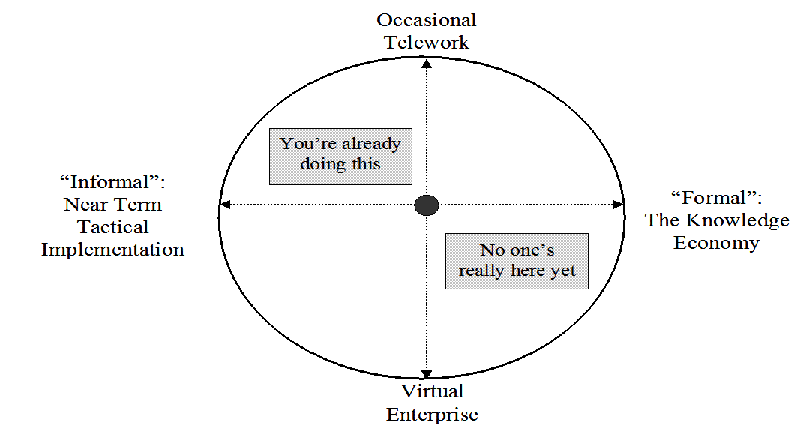
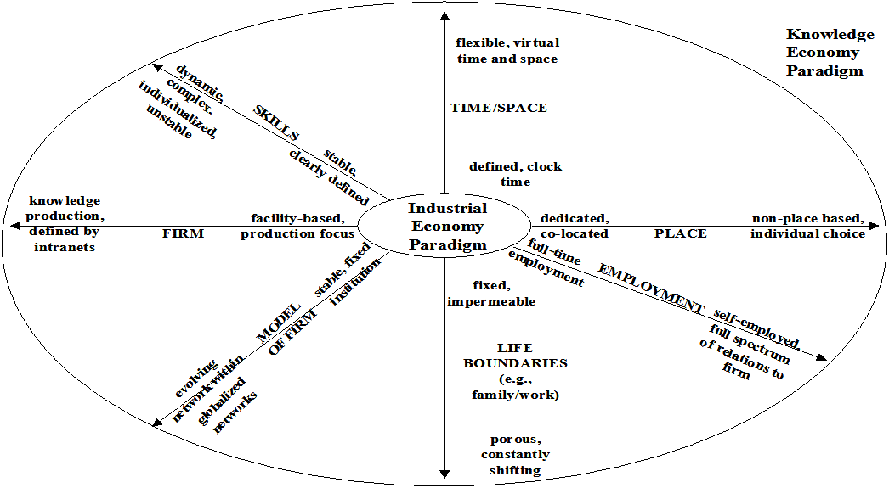 The Changing Dimensions of Work
 Information protection safeguards, such as securing equipment and information when not in use (e.g. locked up before leaving work area)